2012/2013: IEU members defy new hardline Catholic approach
The Victorian Liberal Government, led by Ted Baillieu, came to power in 2010 promising to make Victorian teachers the highest paid in the country. By 2012, that promise had been replaced by a ‘performance pay’ model, in which only a small group would reach nationally competitive rates, leaving most education workers behind.
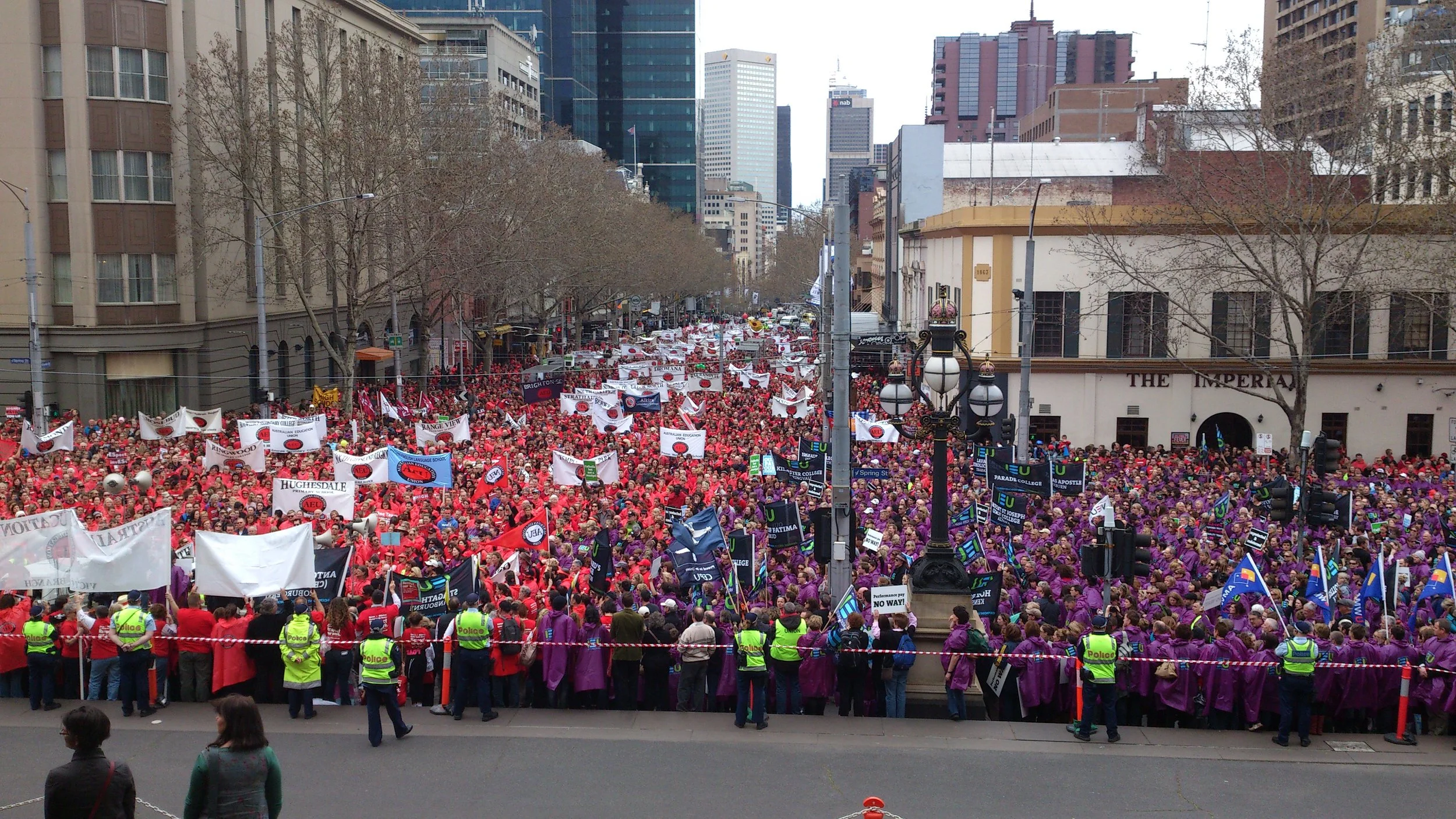
Victorian education unions warned that this was a divisive attack on a collaborative profession. It would discourage teamwork, disadvantage teachers in challenging settings, and add a bureaucratic layer to rate individual performance instead of investing in better support for staff and students.
Alarmingly, the Catholic Education Commission of Victoria (CECV) –the forerunner of today’s Victorian Catholic Education Authority (VCEA)– sought to replicate the approach in Catholic education.
Education unions mobilised together like never before and planned a joint day of action for 5 September 2012.The CECV’s response marked a turning point in Catholic sector bargaining.
The Catholic employer crackdown
Although one Agreement applied across Catholic education, the sector was made up of over 300 employers. The IEU asked the CECV to adopt single‑interest bargaining, enabling lawful protected industrial action in our sector – a basic workplace right recognised internationally and consistent with Catholic social teaching.
The CECV rejected that path by ‘suspending’ negotiations with the IEU, a regrettable decision that still shapes bargaining dynamics today. Employers then sought to suppress protests, threatening legal action against the IEU and its members for taking action mirroring the lawful action of our colleagues in government schools.
The CECV exerted unrelenting political and legal pressure on schools and employees to prevent participation. Staff were divided, those on contracts were warned to consider their future employment prospects, and IEU Reps were summoned to principals’ offices. There was legal action in Fair Work Australia, threats of fines, and propaganda suggesting the protest was somehow ‘against Catholic education’.
IEU Council expressed strong condemnation of the CECV’s opposition– and members turned out in force.
2012: Members voted with their feet
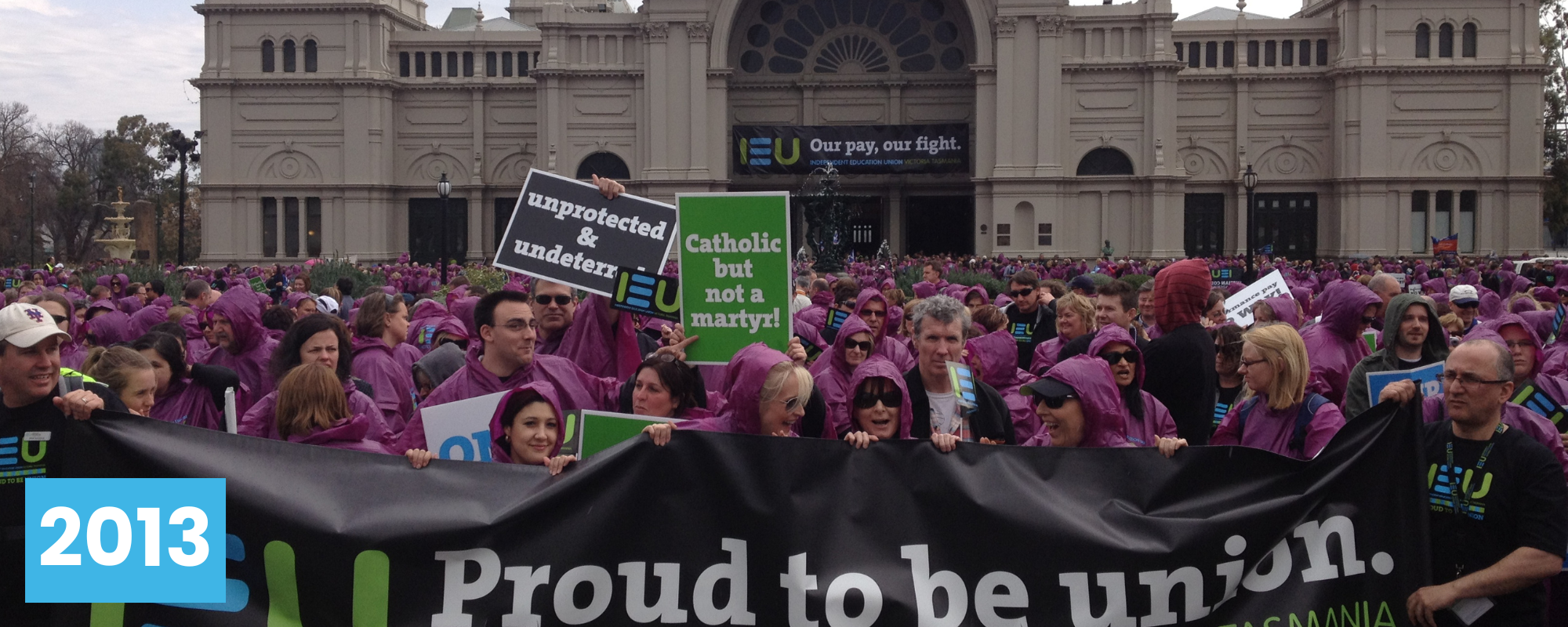
The October 2012 edition of The Point reported the IEU mass-meeting at the Royal Exhibition Building and the joint rally with the AEU as an overwhelming success. It drew the biggest turnout of IEU members seen to that point, most wearing distinctive purple ponchos, and was described as ‘the largest day of protest in Victoria’s history’ for the education community.
Motions against the state government and the CECV were carried unanimously. Then IEU General Secretary Deb James told the huge crowd that while Catholic employers had tried to stop staff standing with colleagues from other unions, the IEU would stay the course.
Days after the rally, the state government recommenced negotiations with the AEU, but the CECV remained unwilling to do the same with the IEU.
2013: Injunctions, escalation, and outcomes
In February 2013, a second major stop-work to protest the lack of a fair pay deal for all school staff was planned.
Days before the event, the CECV applied for an injunction against the IEU. Orders required the IEU to use email and social media to inform members the stoppage was cancelled and that members should not participate. However, the orders did not apply to already well‑organised Reps and members, and by the time employers shut the action down with further legal manoeuvres at 9pm on11 February, much of the organisation had already been completed.
On Valentine’s Day, February 14 2013, around 3,500 teachers, support staff and principals from Catholic education gathered in Treasury Gardens and marched to Parliament alongside thousands of AEU members to send a loud and clear message to Premier Baillieu. Delegations travelled by bus from Bairnsdale, Sale and Maffra, with solidarity gatherings in Wodonga and Warrnambool.
A deal for government school staff was reached in April 2013, and the government’s divisive performance pay proposals were defeated.
However, the Victorian Catholic Agreement took many months longer to finalise and was not approved by Fair Work until 13 November, after nearly two years of campaigning by IEU members. While the IEU successfully negotiated backpay to ensure that staff were not disadvantaged, this extraordinary 7-month delay highlighted again the disadvantages of bargaining without key industrial rights.
From then to now: why fair bargaining rights matter
The 2012–13 dispute marked a clear shift in the Catholic sector: employers increasingly relied on the sector’s multi‑employer structure and legal constraints to limit coordinated action and delay bargaining. While these constraints made unprotected industrial action far more legally risky for IEU members, they did not weaken their resolve, and staff continued campaigning for fair outcomes.
Evidence provided to a Senate Subcommittee by IEU members who worked through this era of employer repression of industrial action was fundamental to the passage of new laws allowing unions to seek Single Interest Authorisations. Our current campaign to win fair bargaining rights in Victorian Catholic schools is the single biggest test of that legislation.