APHEDA-Union Aid Abroad: Supporting decent work in the Pacific and Southeast Asia
Global productivity and wealth are increasing, yet workers around the world are not sharing fairly in that growth. Incomes are falling behind profits, decent work remains out of reach for millions, and since the pandemic, the livelihoods and conditions of many workers have gone backwards.
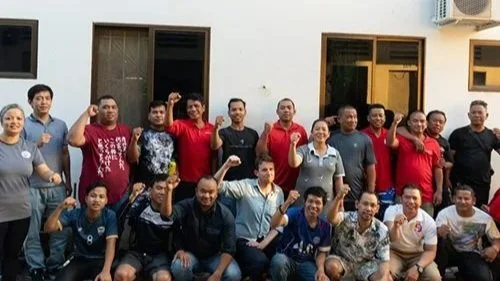
Food and Service Workers Federation members working at Coca-Cola, Cambodia.
This is not an accident. It reflects choices that prioritise capital over labour, weaken collective bargaining, and normalise insecure and informal work.
In this context, Union Aid Abroad–APHEDA and the Australian Council of Trade Unions (ACTU) are deepening their commitment to international solidarity through the Partnerships for Decent Work (PDW) across Southeast Asia and the Indo-Pacific.
PDW operates in 10 countries in partnership with Global Unions, a coalition of major international trade union organisations, including the International Trade Union Confederation (ITUC), and is funded by the Australian Department of Foreign Affairs and Trade (DFAT).
The frontline of the struggle: Indo-Pacific
Across the Indo-Pacific, workers are on the front line of global economic restructuring, climate change, and deregulation. The expansion of informal employment and growing worker vulnerability are undermining decent working conditions.
In the Pacific, particularly in rural and outer-island communities, a majority of workers are engaged in the informal economy, including domestic work, small-scale production, trading, and unregistered services.
In Timor-Leste, for example, 84 per cent of women workers are in the informal economy and are denied basic rights, including written contracts, paid leave, minimum wage protections, and collective bargaining. This is not just an economic issue; it is a gender justice issue.
Workers across Southeast Asia face a similar reality. In Cambodia, around 70 per cent of workers are in vulnerable employment—jobs without formal recognition, income security, or protection from economic, health, or climatic shocks.
Precarious work is widespread across agriculture, manufacturing, and service sectors. These forms of work deliberately fragment the workforce and weaken workers’ ability to organise and bargain collectively.
Building workers’ power through solidarity
PDW focuses on organising workers in both the formal and informal economy, supporting a just transition in the face of climate change, strengthening unions’ capacity to organise and win, and backing union-led campaigns to hold corporations and governments accountable.
One example of this solidarity in action is support for the global union Education International in five Pacific Island nations, where there is a shortage of 300,000 teachers, according to the UN’s High-Level Panel on the Teaching Profession 2024.
This shortage is driven by insecure employment, heavier workloads, unsafe working conditions—especially for women—and low pay, making it difficult to attract and retain teachers.
This work strengthens teacher unions to advocate for decent work, defend public education, and engage in meaningful social dialogue.
With PDW support, teachers can better address staffing shortages, build collective bargaining power, and press governments to honour their commitments to workers’ rights and deliver quality public education for all.
At its core, the ambition through PDW is to build worker power. The program supports unions to organise where workers are insecure, to bargain where rights are weak, and to campaign where governments and employers fail to protect.
It recognises that lasting change does not come from technical fixes alone, but from collective action and a movement led by workers themselves.
Want to support this work?
Become a regular donor and a member of Union Aid Abroad–APHEDA: apheda.org.au/
Education International on public education in the Pacific: ieu.news/981062