
IEU stakes claim for Tasmanian Catholic school staff
The IEU has finalised its Draft Log of Claims for the next round of bargaining for better salaries and conditions in Tasmanian Catholic education. The Draft reflects feedback from members, including last year’s survey results, and draws on the union’s experience supporting staff under the current Agreement.

All sub-branches will now have the opportunity to review the Draft and either endorse it or propose amendments and additional claims.
Following these workplace discussions, elected Reps will attend a special IEU Council meeting in Hobart on 6 March, where they will vote on any amendments and endorse the final Log of Claims. The Log of Claims will then serve as the union’s starting point for negotiations with Catholic Education Tasmania.
Valuing and supporting staff in Catholic Education
The IEU is calling for a single-interest Enterprise Agreement that covers all employees under the current Agreement, protects and improves existing conditions, and reflects fair, equitable, and best-practice standards.
The Log states that the Agreement should guarantee wages and conditions at least equivalent to Tasmanian government schools, acknowledge the growing complexity and demands of the work staff are performing in Tasmanian Catholic schools, and ensure all staff contributions are recognised.
It should also provide sustainable support, enabling staff to balance professional responsibilities with their personal lives. Adequate funding to schools is essential to deliver these improvements.
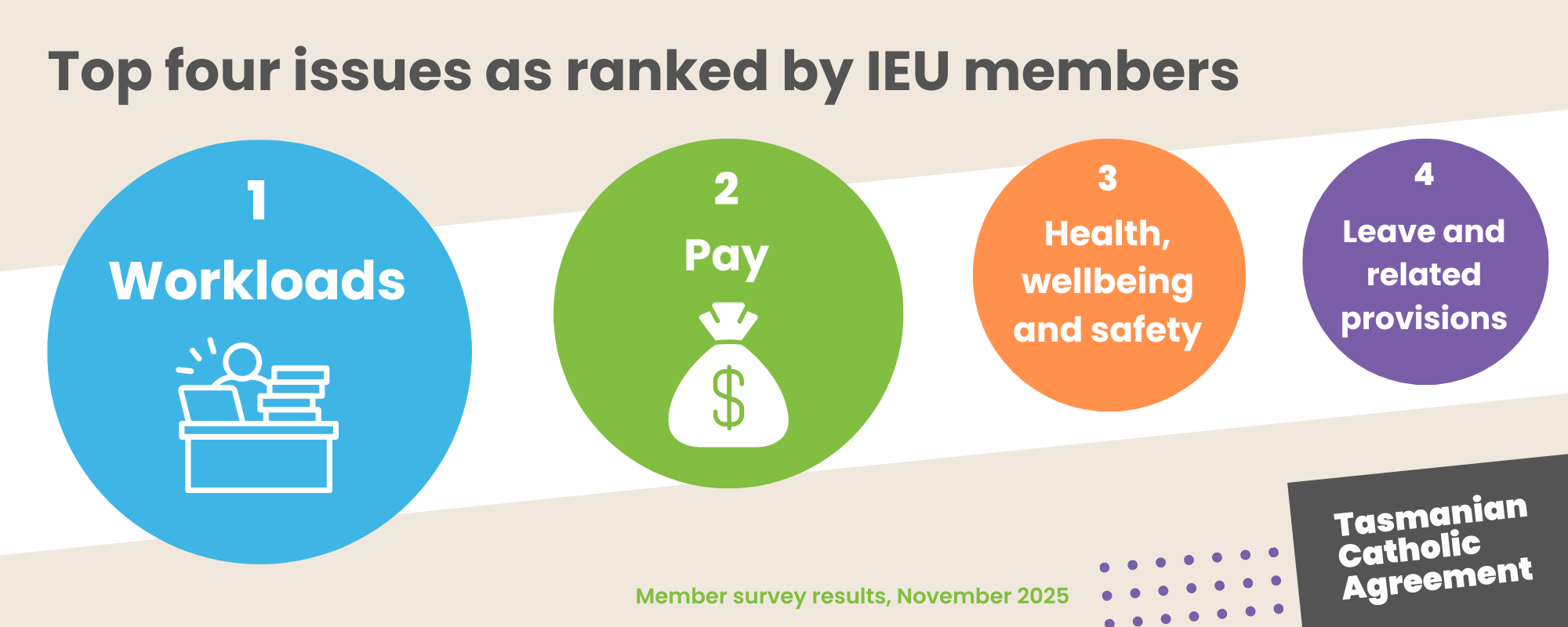
Highlights of the Log of Claims
Remuneration
Salary increases: 12% first year, 5.2% subsequent years.
Superannuation to 15.4%.
“Same job, same pay” for contractors; remove junior pay rates.
Simplified incremental progression and pay relativity for leadership roles.
Compensation for camp duties, supervising pre-service teachers, and practicum.
Workload
Retain 195 days of attendance and school year dates.
Limit out-of-hours meetings to 2 hours/week for all staff.
Preparation time for Teacher Assistants; better support for complex student needs.
Paid lunch break and right-to-disconnect provisions for all staff.
Fair compensation for extra duties (e.g., camps) for all staff.
School Support Employees
Better recognition and updated classification structures that reflect the work undertaken by all School Support Employees
Processes for requesting and assessing reclassification
Preparation time for Teacher Assistants within working hours, and improved support for thos working with working with high-needs students
Teachers
Support for teachers managing students on Individual Learning Plans.
Protect planning time & compensate for missed release.
Supervisions counted in FTE and paid if over max hours.
Reduced instructional loads and clear class size caps.
Health and Safety
Improved reporting of systemic safety issues.
Limit surveillance; prohibit in private spaces.
Employer-funded vaccinations and Employee Assistance Programs.
Strengthened psychosocial hazard management and wellbeing initiatives.
Leave
12 days Reproductive Health and Wellbeing Leave.
Personal leave donation and 2 days flexible leave/year.
Improved accident compensation, 10 days bereavement/compassionate leave, long service leave.
Modernised parental leave: 30 weeks primary, 8 weeks secondary caregiver; flexible, inclusive, and accessible after 6 months.
Pro-rata for part-time staff; leave for survivors of sexual abuse.
Performance and Conduct
Fair processes, including stand-downs, risk assessments, and support during investigations.
Other Claims
No compulsory transfers; improved grievance and implementation processes.
Reduced administrative burden; hard-to-staff and remote incentives.
Time allowances for IEU Reps and recognition of Delegates’ Rights.
Gender-neutral language, Fair Work compliance, induction access, and reasonable school facilities for union representatives.




Meanwhile, in the public sector …
State sector outcomes set a benchmark that strongly influences negotiations across the broader education workforce, including independent and Catholic schools, particularly in Tasmania.
As negotiations in Tasmanian Catholic education approach the starting line, public sector bargaining continues to make headlines. Unions representing public school, health, and other state employees — including the AEU, CPSU, and HACSU — have criticised the state government’s approach to enterprise bargaining and called on Premier Jeremy Rockliff to intervene. In early February, HACSU members staged a three-hour rolling stop-work at Launceston General Hospital and considered further industrial action.
The Rockliff Government has offered a one-year, 3 per cent pay increase across the public sector while longer-term Agreements are negotiated. Unions argue this offer fails to address workload, staffing shortages, overtime, leave conditions, or workplace violence.
In late 2025, thousands of teachers and other public sector workers rallied statewide and held stop-work actions, delaying school openings in several regions. The AEU has indicated that further industrial action is possible if negotiations do not progress.
These public sector disputes highlight mounting pressure on governments nationally to improve pay and address workload and staffing challenges in education.
