Fundamentally, the union is its members. Collectively, members employ and resource union staff to work on their behalf: to amplify their voices, provide professional support, advocate for their needs and to handle complex negotiations.

What is the IEU Victoria Tasmania?
The union’s strength comes from active, engaged members, and its structure reflects this, with all major decision-making roles elected by the membership.
Here is how it all works:
Members
The IEU is represents around 20,000 members in non-government schools and other educational institutions throughout Victoria and Tasmania. Their fees keep the union running and form the power of the organisation. Our members are nearly every type of education worker: teachers and principals, administrative and support staff, specialist educators, learning support and wellbeing staff, canteen workers and maintenance and operational staff.
Sub-branch
Your sub-branch is the members at your school or workplace. It’s the first place to raise concerns, share ideas and connect with colleagues. Sub-branches elect Reps, support each other, coordinate campaigns and link your workplace to the wider union so your voice is heard.
Reps
Reps are elected by sub-branches and are the union’s key contact in each workplace. They represent members with management, share information and support colleagues. Reps link the sub-branch to the wider IEU and have rights and protections under the Fair Work Act to enable them to perform these roles.
Committee of Management (COM)
COM is the IEU’s executive body, made up entirely of elected members from across the sectors our members work in. It sets rules, direction and strategy and meets regularly to keep the union on track.
Elected leadership
The General Secretary and Deputy General Secretary are elected by members, report to COM and direct staff day to day. The General Secretary leads the union, represents members publicly and ensures decisions are carried out. The Deputy supports this work, often overseeing campaigns or operations. They work closely as a team.
Staff
Professional organisers, industrial officers and admin staff are employed to provide expert support, advice and representation – but the union remains its members.
Federal union (IEUA)
Our Branch is part of the federal union with other state and territory branches. IEUA represents and advocates for members nationally on industrial relations, education policy and workplace laws affecting 75,000 members.
State and national affiliations
IEU Victoria Tasmania affiliates with Victorian Trades Hall Council and works with Unions Tasmania. Nationally, IEUA affiliates with the ACTU. These links ensure members’ priorities are represented, give sub-branches the strength of a united movement and help sector wins lift standards across the economy. We are also a member of Education International.
The IEU Victoria Tasmania is not affiliated with any political party.
History
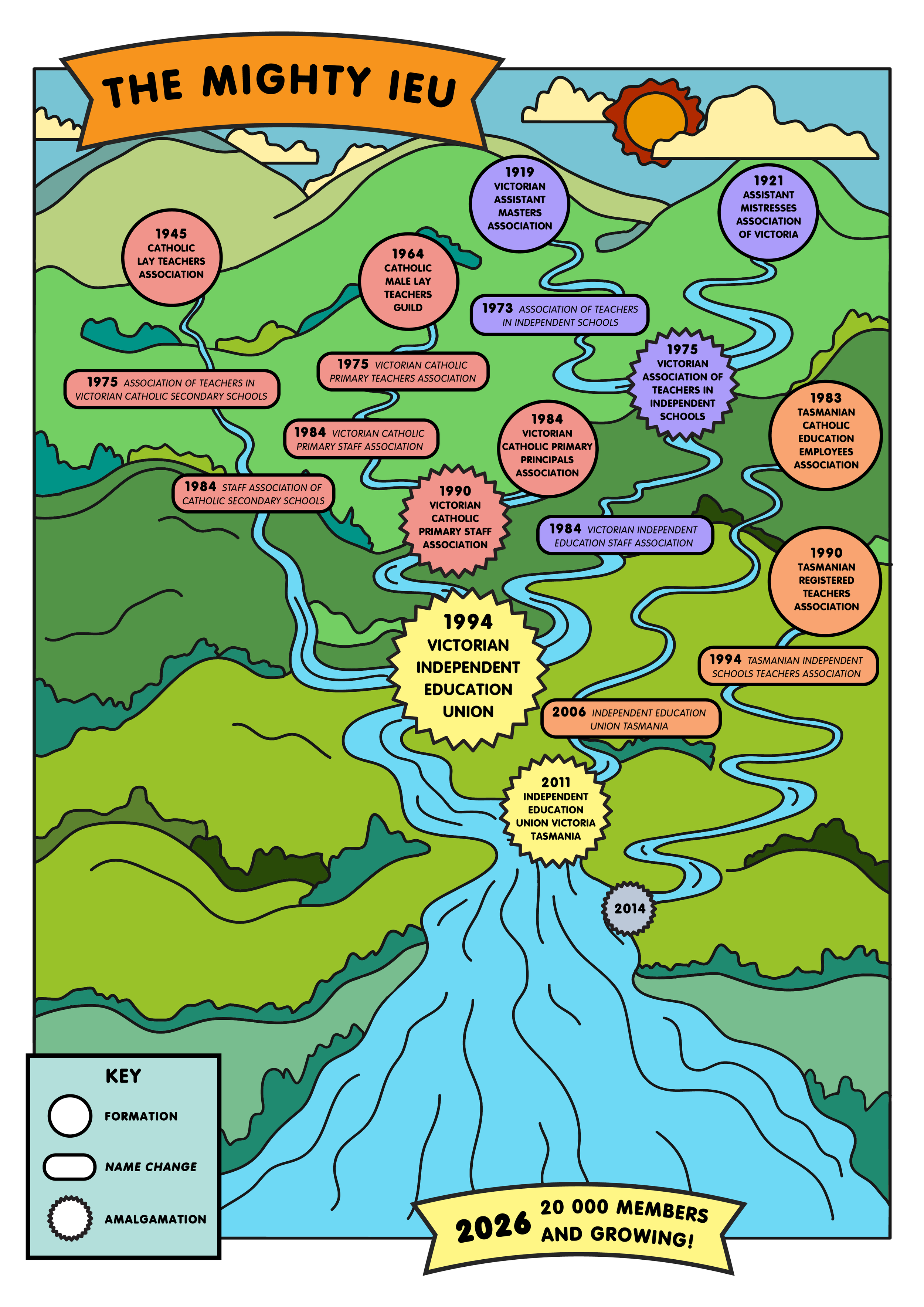
The IEU Victoria Tasmania’s history stretches back to 1919, but the largest forebear of the current iteration is the Victorian Independent Education Union (VIEU), which was formed in 1994 from the merger of various associations representing staff in independent schools and Catholic schools. VIEU became IEU Victoria Tasmania in 2011 after merging with IEU Tasmania. Amalgamation with the Tasmanian Independent School Teachers Association (TISTA) was finalised in 2014.
What is ‘protected’ industrial action and why is it so important?
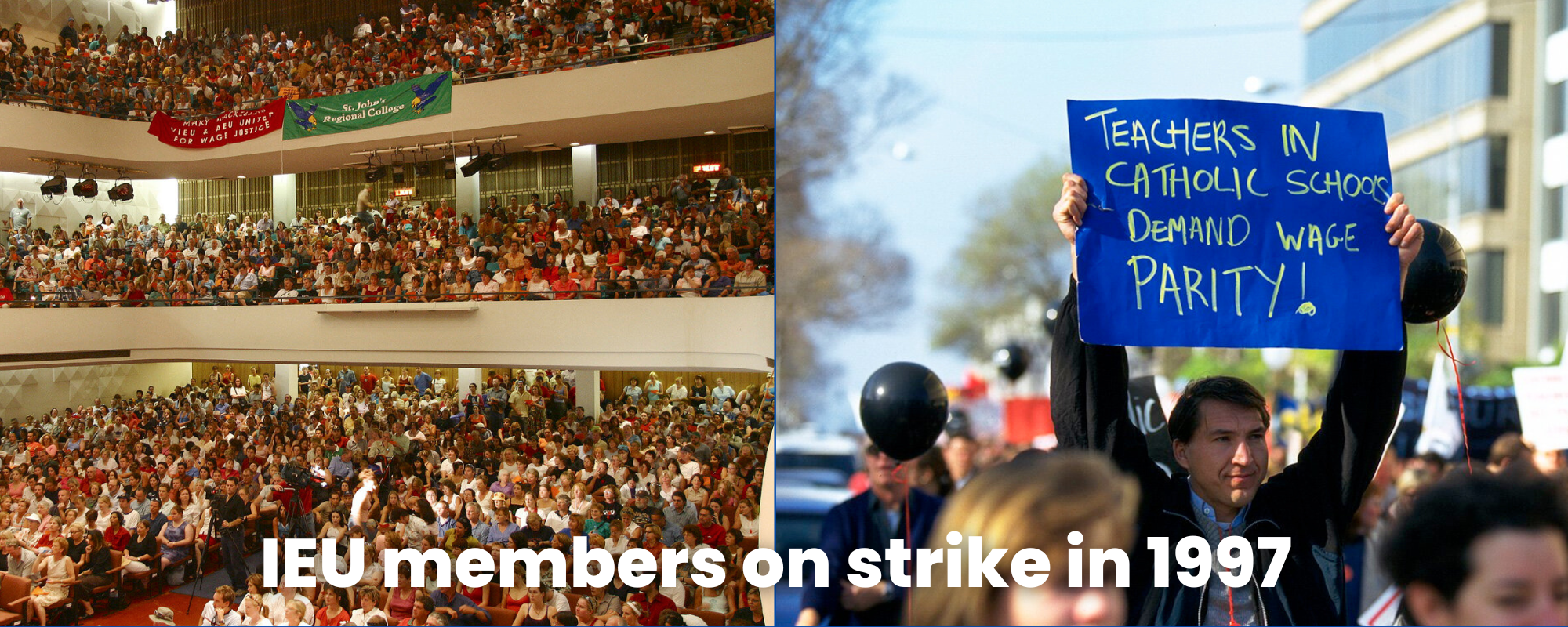
Protected industrial action is a legal form of collective pressure that union members can use as a bargaining tool when negotiating a new Enterprise Agreement. It gives workers the right to take action – from badge-wearing to work bans or strikes – without being punished by their employer.
When can you take protected industrial action?
You can only take protected industrial action when:
Your union is bargaining for a new Enterprise Agreement
Any current Agreement has already expired
A majority of union members vote to take action
The union gives the employer at least three working days’ notice before the action begins.
What does protected industrial action look like?
Protected industrial action can include:
Going on strike (not working for a set time)
Work bans (refusing to do certain tasks, like meetings, emails, or supervision)
Partial work bans (doing some parts of your job but not others)
Stop-work meetings (leaving work briefly to meet and plan)
Other actions, like distributing campaign materials or wearing badges.
Why the prospect of industrial action matters
Collective, coordinated action is how a workforce wins improvement in pay and conditions. When talks stall or offers fall short, the credible possibility of industrial action can give workers the leverage they need to shift the balance and break a deadlock.
A last resort used carefully and lawfully
Protected industrial action is tightly regulated and democratic. Members vote. Legal steps and notices are followed. Escalation is deliberate, often starting with lower-impact actions (bans, limitations, stoppages) and escalating if needed. The aim is not disruption for its own sake; it’s to secure a fair settlement as quickly as possible.
Protected industrial action ensures your voice is heard. When we stand together with a lawful, coordinated plan, we don’t just ask for better, we have the power to win it!
What is fair bargaining in Australia?
When bargaining begins, it is governed by principles laid down in law. Employers must sit down in good faith, hear workers’ claims, respond properly, and treat unions as genuine representatives ̶ not try to bypass or silence them.
The law tries to ensure that all sides follow a set of rules designed to ensure negotiations are respectful, transparent and genuine.
Your rights in bargaining
Good faith bargaining doesn’t mean the employer has to agree to everything workers ask for, but it does mean they can’t ignore them, stall negotiations, or act in ways that undermines their rights. Specifically, employers must:
Attend meetings at reasonable times.
Provide relevant and timely information (not misleading or deceptive).
Genuinely consider and respond to proposals.
Avoid unfair delaying tactics.
Recognise the bargaining representatives (usually a union) properly.
Why fair bargaining matters
These rules keep workers in the process, making bargaining real, so every claim is properly discussed. In education, that ensures that the needs and voices of distinct groups such as teachers, education support staff and school leaders are heard and genuinely considered. Good-faith bargaining guarantees your voice is heard and your union is treated as a genuine partner.

Good Faith Bargaining Orders
Good Faith Bargaining Orders are legal directions issued the Fair Work Commission that compel an employer or a union to negotiate in a genuine, constructive way.
How they work
Enforcement tool: If one side refuses to act in good faith ̶ for example, an employer ignoring union proposals or refusing to meet ̶ the other side can apply to the tribunal for a GFB Order. The tribunal is then able to issue an order requiring the offending party to change its behaviour.
Legal consequences: Failing to comply with a Good Faith Bargaining Order can result in penalties, fines, or further legal remedies.
Why they are important for workers
Protect against employer stonewalling
Without these orders, an employer could drag out negotiations, refuse to share information, or ignore union proposals. GFB Orders force employers to actually engage.Levels the playing field
Employers often hold more power and resources in bargaining. Good faith rules and orders stop them from abusing that power and give workers a fairer chance to secure better wages, conditions, and rights.Strengthens collective bargaining
By ensuring that unions are properly recognised and consulted, GFB Orders help workers have a real voice at the table.Provides legal recourse
Workers and unions don’t have to rely on goodwill alone. If the employer won’t play fair, there’s a mechanism to compel them.Reduces conflict and delays
While industrial action is sometimes necessary, Good Faith Bargaining Orders can prevent unnecessary disputes by keeping negotiations on track.
Good Faith Bargaining Orders give workers legal backing to demand real engagement from employers, making collective bargaining more effective and fair.