
IEU’s grassroots SIA campaign reaches the legal battleground on high

There’s nothing stopping a member of the public from attending a Fair Work Commission hearing. Decisions that shape important parts of our working lives are made in publicly accessible hearing rooms in the centres of major cities.
If you wanted to sit in on the IEU’s Victorian Catholic education single interest authorisation (SIA) hearing, you could have attended Room 5 on Level 9 of the Fair Work Commission (FWC) at 111 Exhibition Street in June.
Even without an expensive suit, you could have stepped into the lift alongside barristers carrying suitcases stuffed with ring binders and travelled to the timber-panelled hearing rooms high above the street, where the future of bargaining across a sector was being debated.
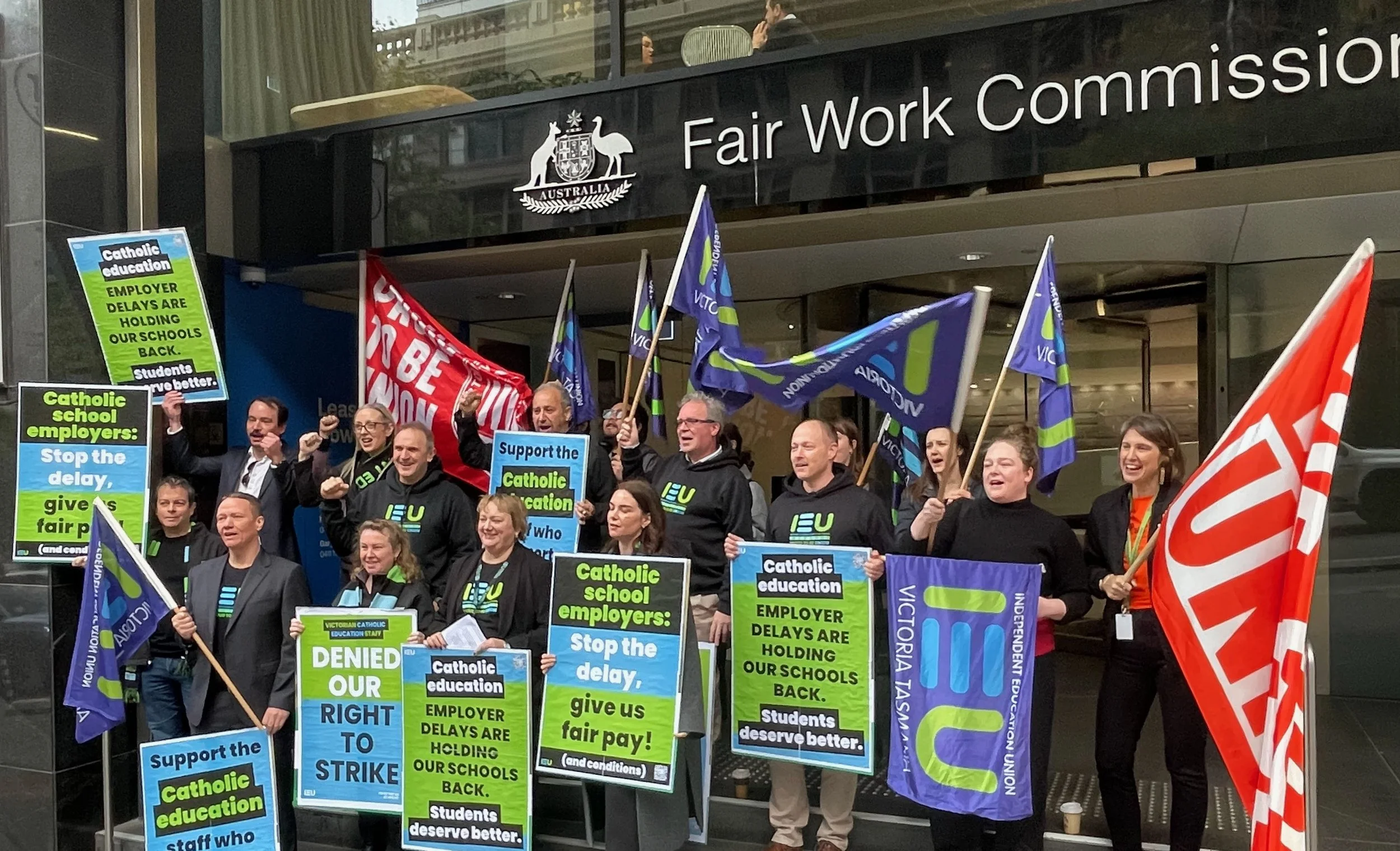
But IEU members have jobs to do and can’t be there. So, here’s a picture of the scene on day one of the hearing.
There are only 20 bolted-down seats, so the 10 IEU attendees each represent almost 2,000 Victorian Catholic education staff who had signed the campaign for long-denied fair bargaining rights.
The lawyers don’t mind the small crowd. Smart, competitive, proud, confident and knowledgeable, they are clearly at home in this muted environment.
For members of the public, however, the hearing room is unfamiliar, slightly uncomfortable territory.
Should we stand when the Deputy President enters the room?
Are we supposed to bow upon entering and leaving the room once he’s there?
(Yes, and yes, though you aren’t informed of this beforehand.)
The Deputy President advises that photographs and recordings are not permitted in FWC hearing rooms, and that mobile phones must be switched to silent.
Room 5 is understated and bland, understandably functional, a small space of horizontals: members of the public along the back wall, lawyers at a long shared bench in the centre and, behind a waist-high partition, a couple of stern-faced clerks.
At the rear, slightly elevated, the Deputy President sits alone, the Australian coat of arms behind him. (This is what you are bowing to, not the Deputy President.)
To the right is a witness stand with a podium and microphone, just like on TV. And yes, witnesses are sworn in and utter those weighty words: ‘the truth, the whole truth and nothing but the truth’.
At the outset, as the lawyers and Deputy President deal with housekeeping about how the matter will proceed, the atmosphere is congenial. There are frequent references to ‘my learned friend’ as the applicant’s barrister outlines the main issues and how he expects the case to proceed, often receiving cordial agreement from the barrister representing the Catholic employers.
Downstairs, minutes earlier, IEU members waved flags, delivered speeches and chanted ‘Union Power!’ and ‘Fair bargaining: SIA!’
Now you can’t hear a pin drop, the grey carpet muffling the barely audible legal pleasantries.
Our lawyers have a complex and demanding role.
Nearly every page of their folders contains highlighted passages mapping anticipated arguments, responses and key points drawn from thousands of pages of witness statements, the Fair Work Act 2009 (Cth) and previous cases.
They function like human computers, filtering vast amounts of material under pressure as they present the union’s case.
They are dealing with a new area of law shaped by recent legislative amendments. It’s exacting, hard-fought work.
But all these finely tuned minds are only making these arguments because thousands of union members supported this application.
They were supporting a simple principle: every worker deserves access to protected industrial action where permitted by law, and the opportunity to pursue a fair outcome through fair bargaining.
It’s easy to lose sight of that in this legal battleground, with sentence seven under tab 34 on page 238 under the microscope.
But this technical argument is possible only because generations of workers fought to establish rights in workplaces, parliaments and courts.
Making principles a reality takes workers campaigning with commitment and persistence, as IEU members have done for the past year.
Sometimes the campaign is conducted out the front of a school, chanting or handing out pamphlets.
Sometimes it is conducted through legal representatives, in Room 5, Level 9, 111 Exhibition Street.
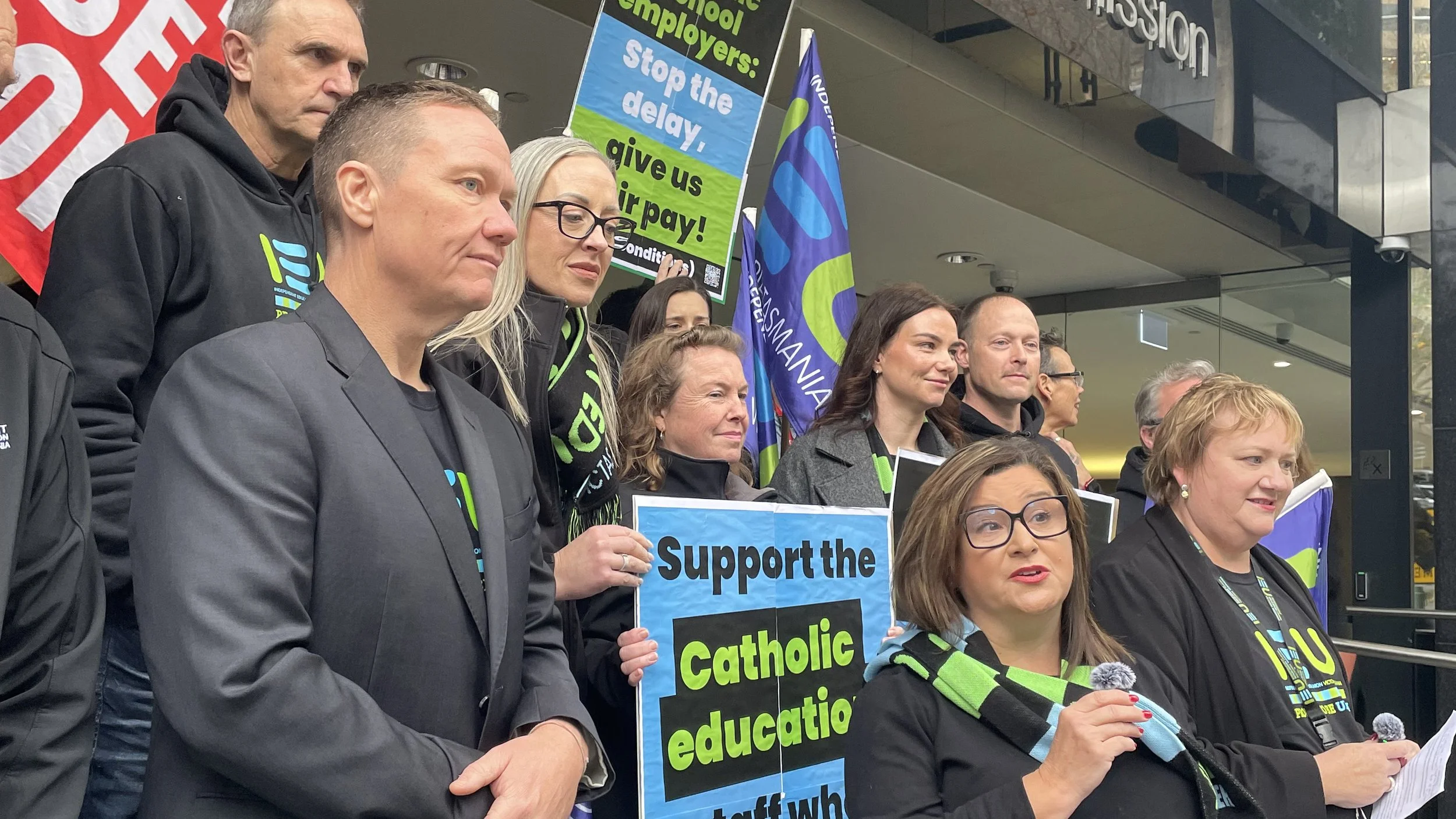
IEU Deputy President Alex Abela speaks outside the Fair Work Commission, 16 June.