
Deputy Prime Minister hears IEU concerns over Catholic sector bargaining
Thanks to the work of members, the IEU secured an opportunity to speak with Deputy Prime Minister Richard Marles about bargaining issues in Victorian Catholic schools.
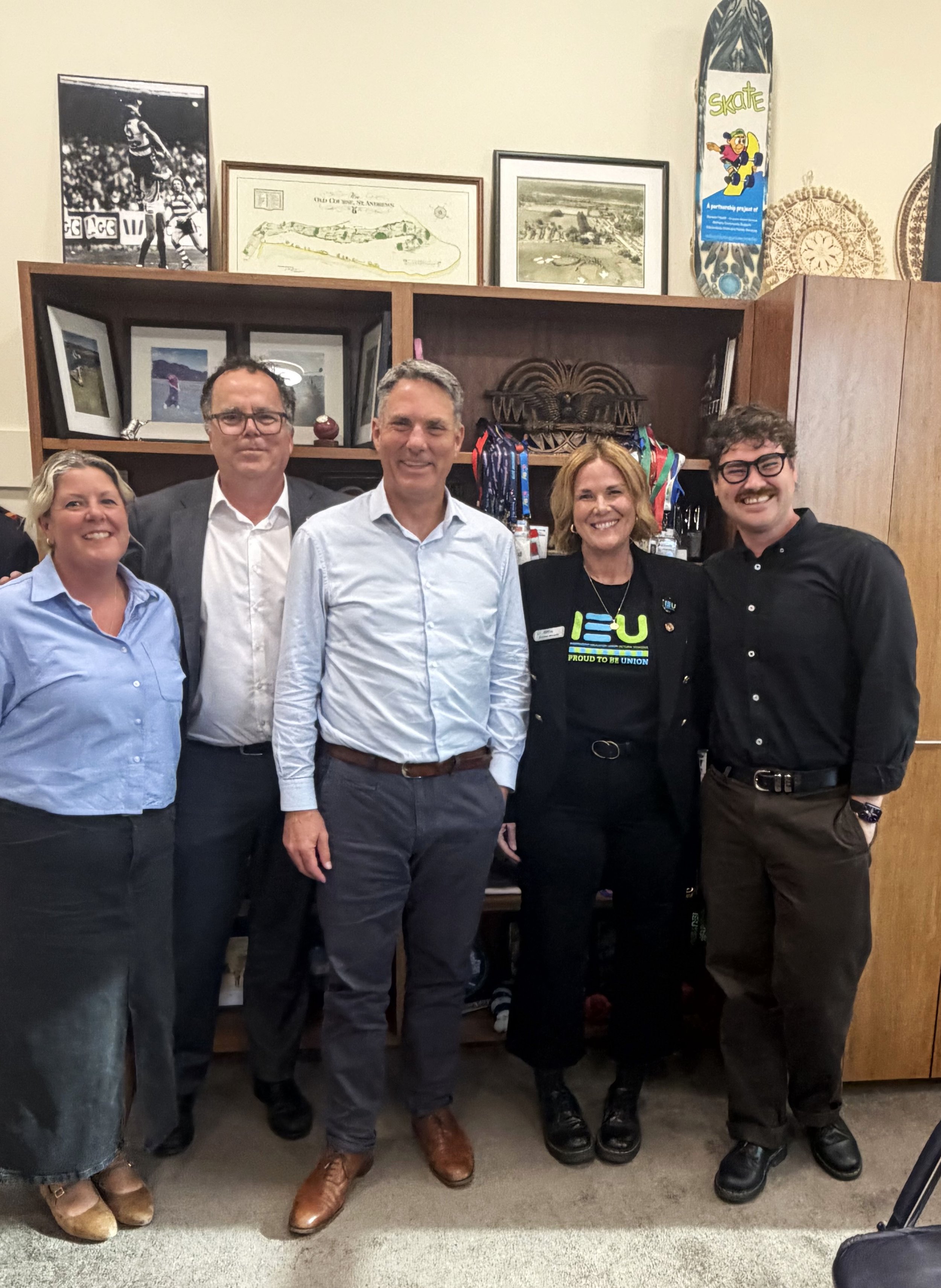
Rep Lauren Hall, IEU General Secretary David Brear, Deputy PM Richard Marles, Organiser Heather Macardy and Rep Charlie Purdy
Marles is the 19th Deputy Prime Minister of Australia and has been Minister for Defence since 2022. He has also been Deputy Leader of the Labor Party since 2019 and the member for the Victorian division of Corio since 2007.
It was this local connection that created the opportunity. Marles attended the Geelong Labour Day Dinner, where IEU stalwart Lauren Hall received the Geelong Women Unionists Network’s Woman Unionist of the Year award.
That led to a follow-up meeting, where Marles spoke with IEU General Secretary David Brear, Lauren, a Rep at St Joseph’s Newtown, her co-Rep Charlie Purdy, and IEU organisers.
David says, “We explained to the Deputy PM how legislation that is supposed to deliver better rights and better outcomes to workers can fail to do so when employers drag things out to such an extent that timely resolution just can’t be reached.
“I think Mr Marles understood our concerns and he undertook to take up our issues with his parliamentary colleagues”
The discussion focused on the limits of current legislative reform around multi-employer bargaining. While initial steps have been taken, the framework still grants significant power to employers. Unions and members must undertake substantial organising to secure a single-interest authorisation (SIA), which provides industrial rights common across most other sectors.
After securing 19,000 signatures in support of an SIA, the union is now facing delays as employers struggle to produce the data required for the Fair Work Commission to finalise its decision.
Marles expressed particular concern on learning that Catholic employers had attempted to bypass proper bargaining by making an offer to staff before engaging with the union’s log of claims.
IEU representatives outlined how this approach constitutes union-busting and risks setting a broader precedent. Marles agreed, expressing disappointment that Catholic employers had adopted this tactic and noting that it undermines genuine bargaining. He also acknowledged the frustration of members facing repeated delays and barriers in their SIA application.
The discussion also addressed claims of parity between Catholic and government sector outcomes. Lauren and Charlie emphasised the importance of solidarity with the AEU, collective action, and achieving outcomes together. They noted that members should not rely on government sector colleagues to secure gains, while highlighting the results achieved when IEU and AEU members worked together.
Richard Marles concluded by asking how he could assist, committing to:
• Speak with Amanda Rishworth, Minister for Employment and Workplace Relations, about concerns with the SIA application and potential legislative reform.
• Consult with Sally McManus of the ACTU on the broader implications of the SIA application and possible avenues of support.
The meeting underscored the importance of continued advocacy, coordination, and engagement with political allies to secure fair outcomes for Catholic sector employees.