Prices are soaring, but wages are not. Meanwhile, the war in the Middle East has increased the humanitarian crisis in Iran, Lebanon and Palestine, and put pressure on global supply chains, making everyday life more expensive.
The cost-of-living hike may be global, but so is our power.
While the powerful try to divide us, people are standing together and refusing to accept exploitation as the new normal.
APHEDA has been hosting two Timorese women union leaders who show that when workers unite, they can rewrite the rules of their own lives.
Domestic workers’ power
In Timor-Leste, which gained independence on May 20, 2002, women make up a significant share of the workforce, yet over 60% are in informal, low-wage, and often unsafe jobs. Many work as housekeepers, carers, or in other precarious roles, where exploitation is often treated as normal. María Dos Santos, Secretary of the Domestic Workers Union (STD-TL), is working to change that.
STD-TL was formed last year and reflects the power of collective action. Women who were previously isolated are now organised and building a movement for long-denied labour rights.
María’s older sister worked as a domestic worker. When she married, she stopped working and encouraged María to take the role instead. Her family and friends did not want her to become a domestic worker, but she did so to support her education.
In 2024, she learned through friends about support being offered by the Working Women Centre of Timor-Leste (WWCTL). She became involved in their activities, which helped her transition into aged care work when her employers could no longer afford her wages.
“In 2025, at our congress, we decided to form a union, and I was elected General Secretary. I wasn’t sure if I could lead them. But with support from Union Aid Abroad–APHEDA and WWCTL, I gained the confidence to put my hand up,” she said.
A national movement for fair wages
The fight extends beyond domestic workers. Manuela Da Conceição Orna, an organiser with the General Workers Union (SJT-TL), Timor-Leste’s largest private sector union, is campaigning to raise the national minimum wage.
Manuela’s experience began in a casino in Dili, where conditions were difficult and union activity was discouraged. After having a baby in 2023, she resigned, reflecting a common pattern in insecure work. Her mother encouraged her to join a union and stop being exploited. She did, and began organising hotel and restaurant workers, helping them understand their rights and build collective strength.
Manuela is clear about the challenge: “Sometimes I want to give up, but with the union I feel strong. If you have a problem, you should speak up so the union can help you. If you stay quiet, things won’t get better.”
Why this matters
The stories of María and Manuela reflect both lived experience and a model for action. In a world where wealth inequality is growing, union-busting is increasing, and workers are under pressure, global solidarity remains central to shifting power.
When we organise, we win.
The IEU Victoria Tasmania branch connection with Timor
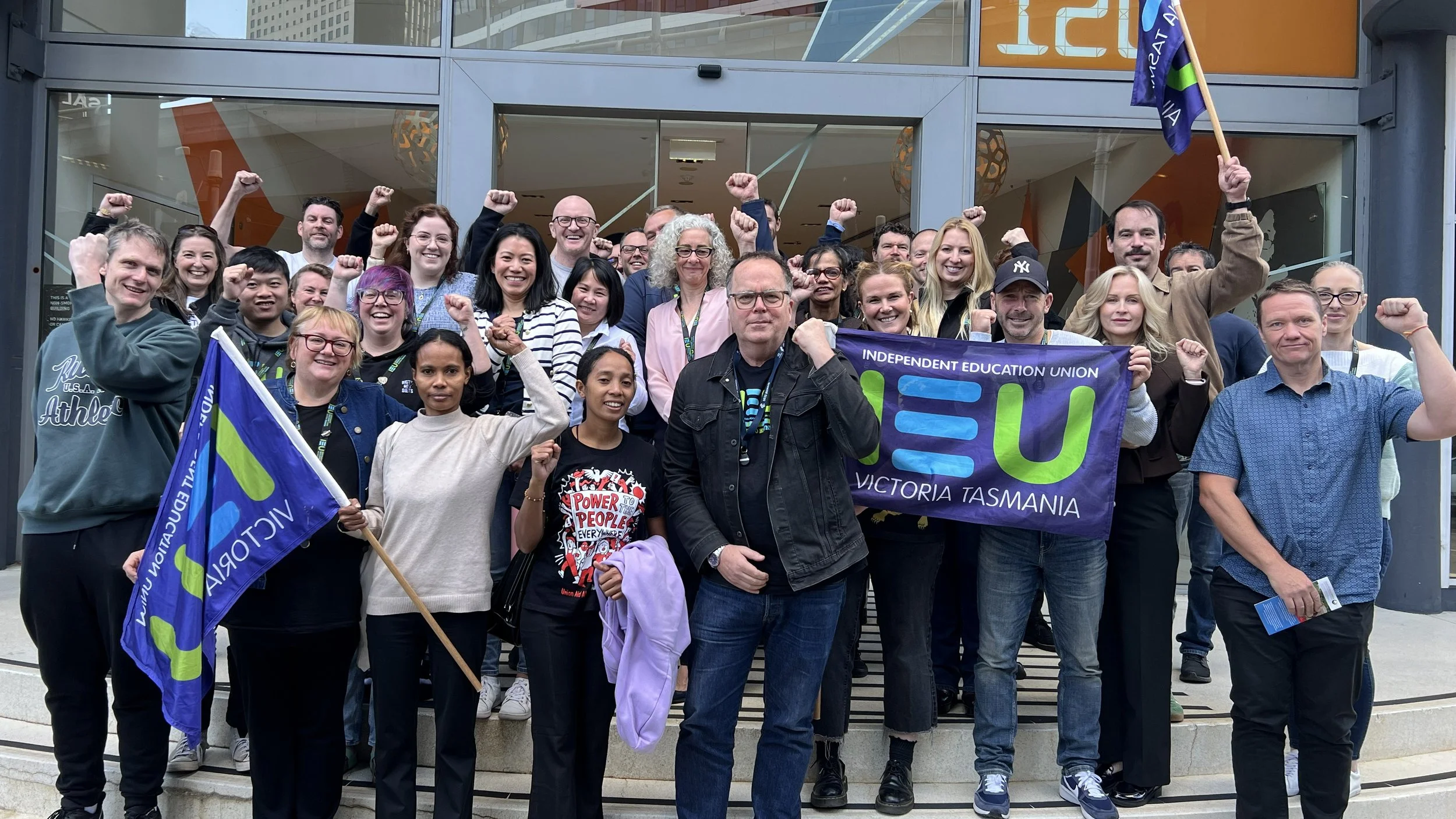
Maria and Manuela visited the IEU office during their stay and spoke to staff about the challenges they faced, receiving a warm welcome.
Their visit renews a long association. The IEU played a significant role in supporting East Timor’s rebuilding of its education system following the 1999 independence vote and the widespread destruction that followed. In the tense lead-up to the referendum, an IEU delegation including Deb James, who would later become General Secretary, travelled to Dili to deliver medical supplies to volunteer clinics and provide solidarity support at a time of heightened risk and military presence.
In the post-independence period, the union helped establish teacher education capacity in Baucau through a partnership with Australian Catholic University, coordinating and supporting placements for Australian teachers when no formal training system existed. This work contributed to the early development of local teacher training and education infrastructure during a critical nation-building phase.
We have retained strong links to union work in Timor, including through APHEDA.