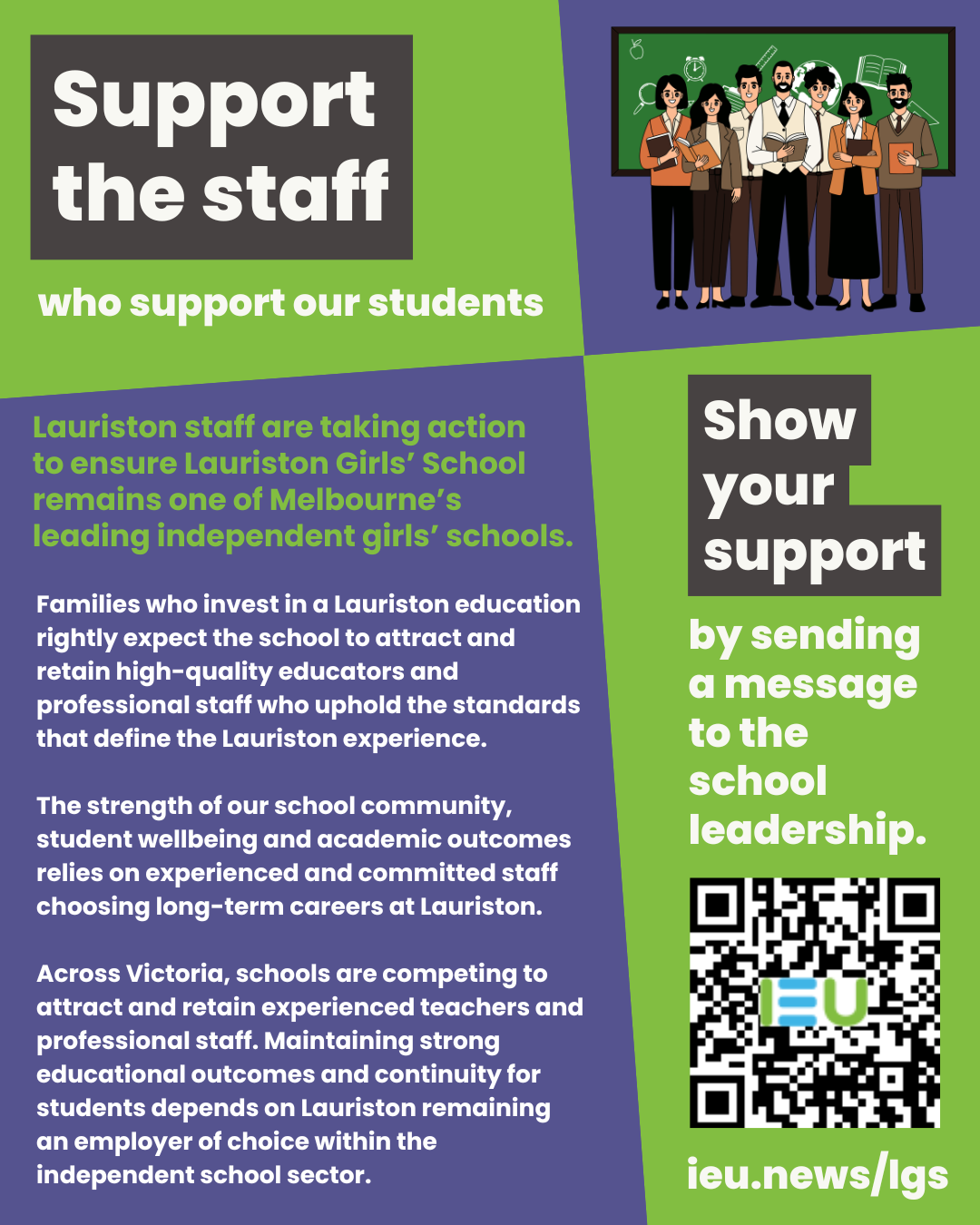
Across the independent school sector, staff are increasingly willing to reject proposed enterprise Agreements that do not meet their expectations.
IEU General Secretary David Brear says, “Recent successful ‘no’ votes at Lauriston Girls’ School, Aitken College, and Gippsland Grammar highlight that IEU members are prepared to demand better offers, reflecting concerns about pay, workload, and working conditions in a challenging economic climate”.
“A primary driver of these ‘No’ votes has been salary. Staff are comparing proposed increases not only against their current earnings but against the broader economic context – and finding them lacking. The in-principle deal in Victorian government schools represents another benchmark that independent schools will need to match or beat if they want to attract and retain staff in a time of education worker shortages.”
Staff facing sustained cost-of-living pressures, higher inflation, rising interest rates, and increasing fuel and household costs no longer see modest pay offers as acceptable. They expect salaries that reflect the professional value of their work, their current financial pressures, and the need to maintain the school’s financial stability.
When independent school proposals fall short of these expectations, employees are increasingly voting them down.
Staff now see a ‘No’ vote not as a risk, but as a legitimate and effective step in the bargaining process.

Striking unionists at Lauriston.
More than money
While salary is central, it is not the only issue driving ‘No’ votes. Workload remains a persistent concern. Teachers and Education Support staff continue to report increasing administrative demands and insufficient recognition of the hours required to perform their roles effectively.
Flexibility is also a growing priority, with requirements around attendance, meeting schedules, and the ability to work offsite or leave when not engaged in directed duties facing increasing scrutiny.
Staff now see a ‘No’ vote not as a risk, but as a legitimate and effective step in the bargaining process.
Staff are seeking Agreements that recognise sustainable work practices and genuine work-life balance. Where proposed deals fail to address these needs, dissatisfaction grows even when pay increases are offered.
Stronger voices
The recent ‘No’ votes signal a broader shift in bargaining dynamics within the independent sector. Historically, many agreements were accepted with limited resistance. Now, staff are more willing to engage actively in the process and assess proposals critically.
This does not reflect a breakdown in goodwill. Rather, it reflects a more engaged workforce that understands its collective strength and is prepared to use it. As a result, transparent communication and genuine engagement with staff concerns are now essential to reaching agreement.
The successful ‘no’ votes at Lauriston, Aitken, and Gippsland Grammar will influence negotiations across the sector in the coming months.
For employers, the message is clear: agreements must align with both economic realities and workforce expectations. Competitive salary increases are essential, but they must be accompanied by meaningful improvements in workload and working conditions.
Premium issues
Staff in independent schools are closely monitoring government and Catholic sector bargaining and assessing their relative position on pay and conditions, including any premiums they hold over those sectors and the extent of any reduction they would consider acceptable once those Agreements are finalised.
Schools that recognise the need to maintain a competitive position – whether through salary, workload provisions, or flexibility – will be better placed to reach agreement and attract staff.
IEU members and their colleagues have shown they are willing to stand firm in pursuit of fair outcomes. Schools that recognise and respond to these expectations will be best placed to secure agreements supported by staff.
The message is clear: staff are no longer prepared to accept less than what they believe is fair.