The VCEA has put an offer on the table. It contains significant salary improvements – but with many strings attached.
We want every staff member to know what’s at stake. The Dirty Dozen will focus on twelve key concerns, drawing on your survey responses and the bargaining team’s analysis.
Catholic employers have promised pay parity with government schools, but are holding backpay to ransom by making it conditional on reaching agreement in principle by 15 November. Withholding the backpay needed to match government-school earnings would break the parity won nearly three decades ago. Employers can and should guarantee full backpay while fixing these concerns.
There are still too many backward steps and unresolved conditions for us to simply sign up. In our recent survey, around three in four respondents answering the deadline question favoured either continuing bargaining beyond it if needed while insisting on full backpay, or reaching agreement only with firm written guarantees protecting outstanding conditions.
We’ll add each new issue to this article as the series progresses. Please check back and share this page with colleagues.

#5: Protect teacher flexibility
The current Agreement allows teachers to absent themselves from the workplace when they are not required for scheduled duties – a provision that does not exist in government schools.
When the IEU first negotiated this provision into the Agreement many years ago we agreed with the employer that this provision should be limited to “occasional” use. This was expressed in a guidance note which sits outside the Agreement, and was the best way to secure this right for staff in Catholic schools.
In practice, teachers and principals at many schools have agreed to regular arrangements that allow teachers to absent themselves when not required, arrangements that work well for both the teacher and the school. With changes in broader attitudes to flexible work, members have told us that flexible work arrangements are very important to them, and have asked: if it works for them and for their school, why should this right be limited to occasional use?
Victorian Catholic employers now want the Agreement to specify that teachers may absent themselves only “occasionally ”, and stipulate that absences should not be on a regular basis and must be subject to the “operational requirements of the school.” Operational requirements should of course be considered, but the IEU is concerned that this wording is so broad that it could be used to deny teachers access to flexibility in almost any circumstance.
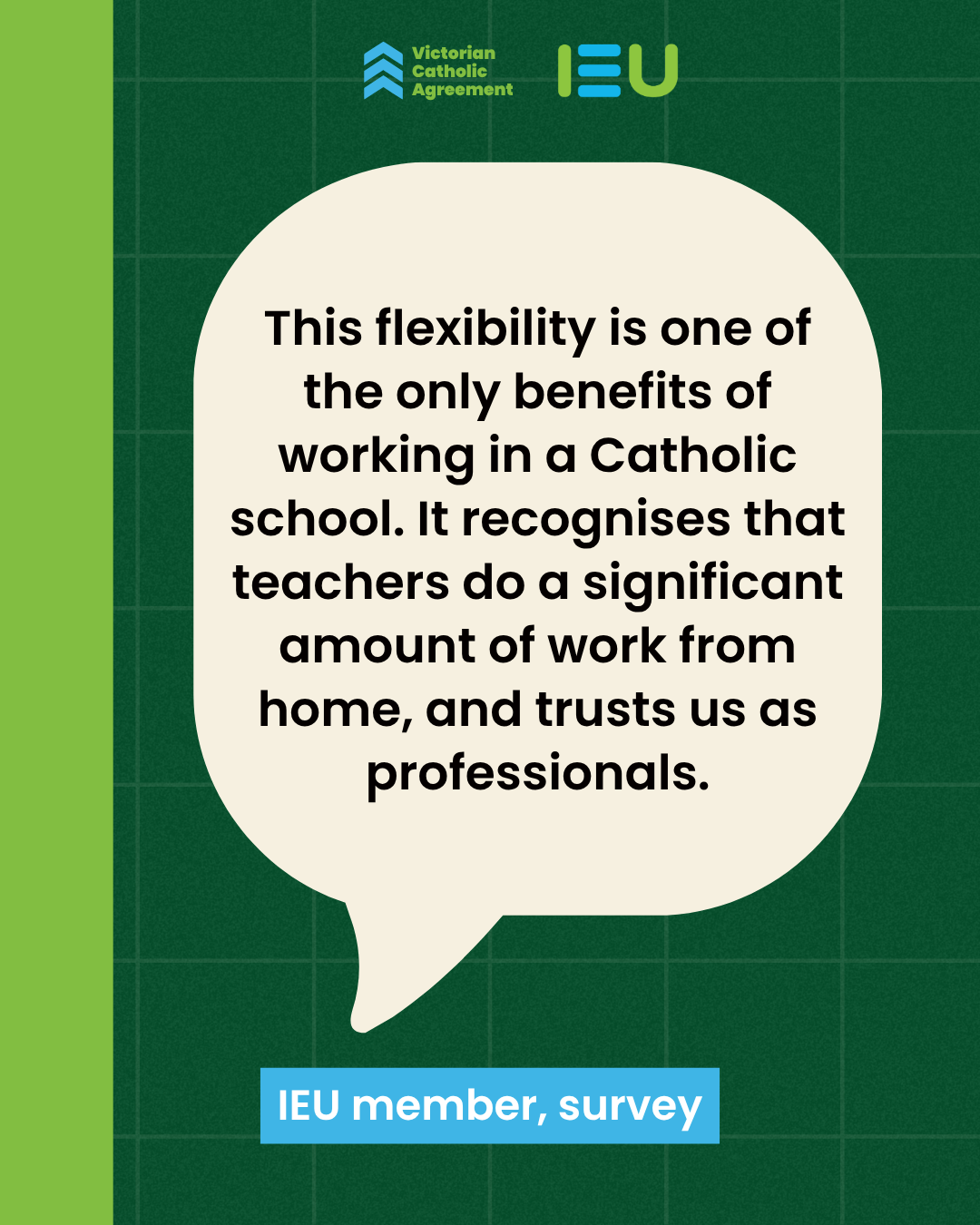
Flexibility helps staff manage professional work, appointments and family responsibilities. Teachers already perform significant work at home and should be trusted as professionals.
In our recent survey, 75% of respondents were concerned about the proposed restriction.
We’re seeking improved wording that protects workable arrangements and supports professional flexibility alongside teaching, supervision and meeting responsibilities.
Employers can pay staff now while the remaining issues are resolved. A fair pay rise should not come at the cost of professional flexibility and trust.


#4: Five days for how much extra work?
Five employer-scheduled days off may sound good. But how much extra work would teachers have to perform in return?
Under the revised offer, full-time teachers could be required to perform up to 38 hours of covered additional duties for the five days. Camps would sit outside that limit and instead attract a separate allowance, which remains substantially lower than the equivalent government-school payments.
The revised offer strengthens the requirements for schools to plan these activities. However, actual hours would still not be routinely recorded or individually reconciled.
The IEU believes the proposed 38-hour limit remains too high. Teachers already perform hundreds of additional hours of planning, preparation and assessment outside the school day – and under the latest revision to the offer, will still have 20 more hours of employer-directed time than their colleagues in government schools. They should not be required to perform another 38 hours of directed duties simply to receive the five days.
The proposed limit would not provide the same protection to POL holders. Additional duties associated with their leadership position would be excluded from the 38-hour cap, potentially leaving no clear upper limit on the additional duties they could be required to perform.
In our recent survey, 73% of teachers wanted clear limits on the five-day model or preferred current TIL arrangements.
We’re seeking a lower cap, clear protection for POL holders, recognition of actual additional work and secure TIL provisions in the Agreement.
Full backpay and fair conditions are not alternatives. Employers should pay staff now while fixing the remaining problems with the offer.

#3: Part-time pay under threat
The current offer contains two proposals that could leave part-time staff receiving less pay for the work they do.
The first changes how part-time fractions are calculated. Currently, a part-time employee’s full-time equivalent (FTE) fraction is rounded up to two decimal places. For example, an employee working 0.614 FTE is paid at 0.62. Employers propose introducing ordinary rounding, which would mean that employee is paid at 0.61 instead. This could cost some part-time staff more than $1,000 a year.
A lower paid fraction does not necessarily mean less teaching, preparation or administration. Staff could still be doing the work while receiving less pay.
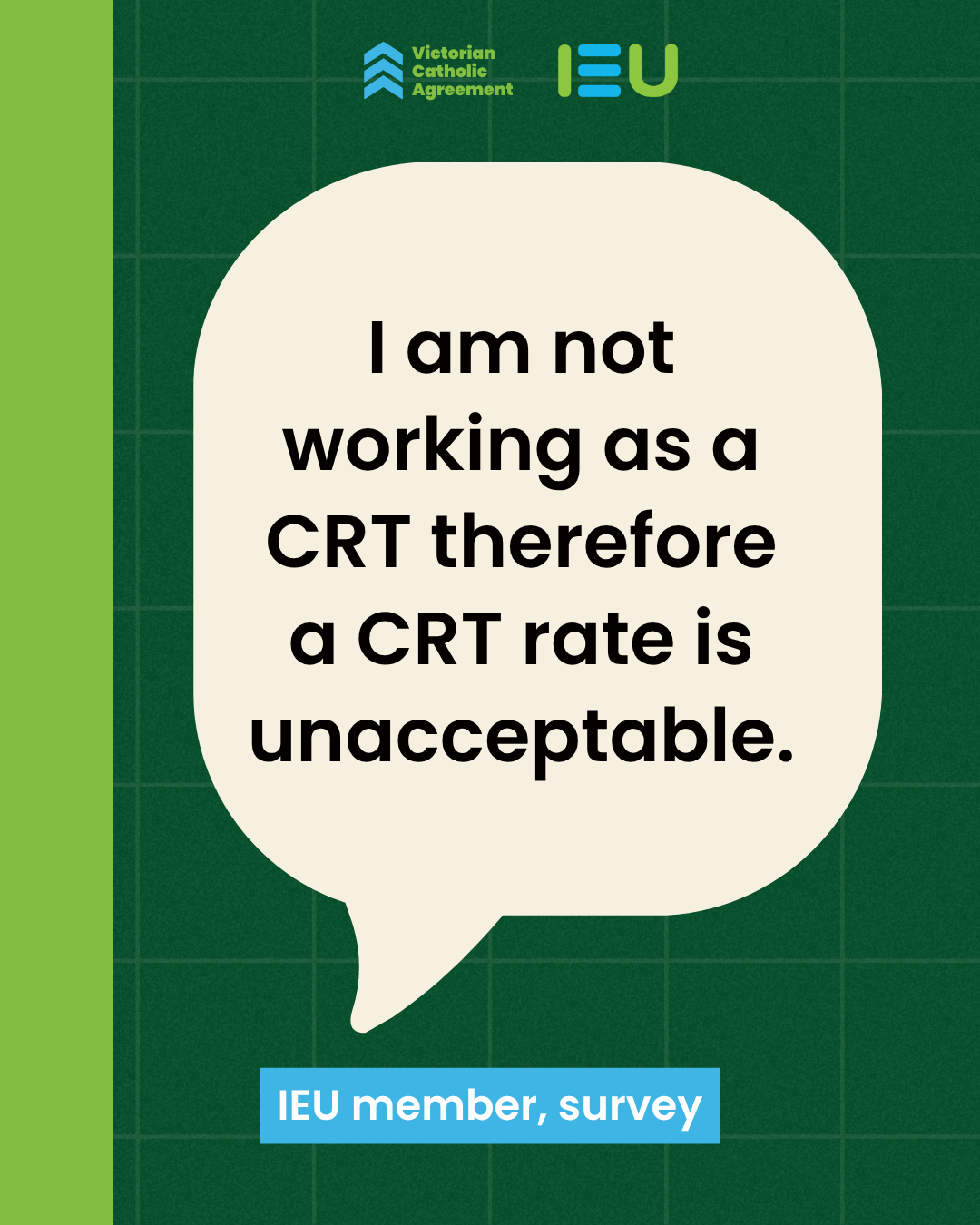
The second change affects part-time teachers undertaking ad hoc additional teaching hours. These hours would be paid at CRT rates rather than the teacher’s own hourly salary rate plus an 18% loading. Teachers would receive less for each additional teaching hour, with the largest losses affecting more experienced teachers.
In our recent survey on the employers’ September proposal, a majority of respondents answering the rounding question opposed replacing rounding up with ordinary rounding. The survey was conducted before the revised offer was announced.
The IEU is seeking protection of paid time fractions and existing additional-hours payments. Part-time staff should be paid fairly for the work they do.


#2: ES overtime at risk
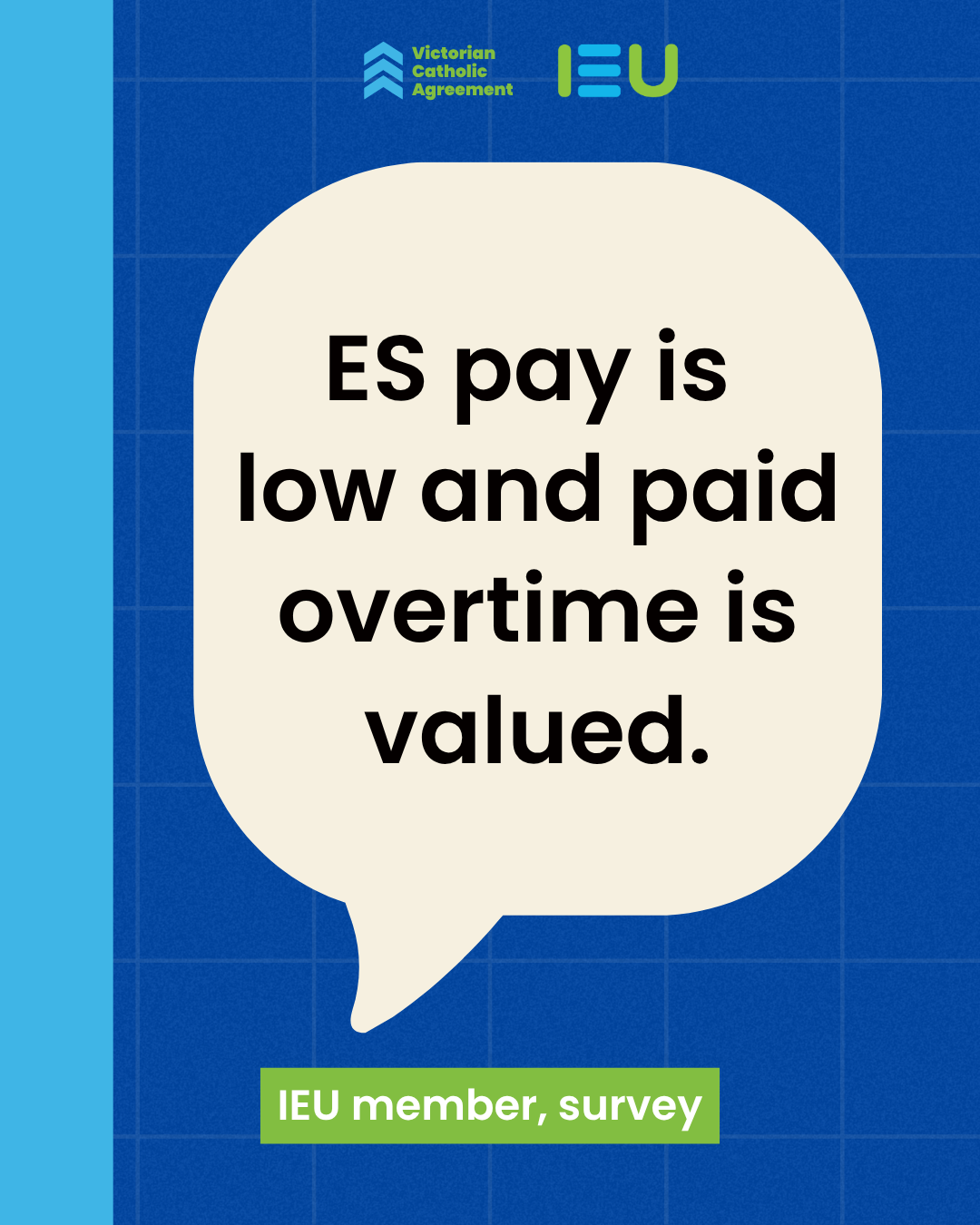
Under the VCEA’s proposal, specified after-hours duties – including meetings, parent–teacher nights, events and open days – would no longer be compensated with overtime pay or negotiated time off in lieu. They would instead be compensated through a minimum of five days off work each year. The employer would schedule those days off, potentially at the end of the year. Employers would also have greater scope to direct the extra work, with less scope for staff to refuse.
Paid overtime helps pay household bills, while extra duties also affect family commitments. Employer-scheduled time off months later does not replace the income or flexibility staff need.
In our recent survey, 71% of support staff answering the overtime question wanted safeguards for the five-day model or to retain the current provisions.
The IEU has been seeking fair payment, clear limits on extra hours and meaningful protection of personal and family commitments.


#1: More meetings and less time to prepare for teachers
From next year, Victorian government schools will have a 40-hour annual cap on required teacher meetings and 40 additional hours reserved for teacher-controlled professional work. The Catholic offer provides neither protection, meaning teachers could be required to attend up to 40 more hours of meetings each year than their colleagues in government schools.
We all know that teachers need more time for planning, marking and assessment during the working week. More directed meetings push that work into evenings and weekends. The employers’ failure to recognise this erodes the value of a pay rise and leaves teachers without equivalent protections for their time.
In our recent survey, 63% of teachers answering the workload question preferred the government arrangement: a 40-hour annual meeting cap and 40 additional hours of class focus time.
The IEU has been seeking a clear annual meeting cap, protected preparation time and recognition of the additional work actually required.