Victorian Catholic education staff are resisting pressure to accept inferior conditions in return for overdue salary increases, with an IEU survey finding three-quarters of respondents would take protected industrial action if legally able.
More than 4,600 members responded to the survey. Only 20% supported reaching agreement by the employers’ 15 November backpay deadline while conditions remained unresolved. Another 76% wanted either continued bargaining with full backpay or agreement by the deadline only with firm written guarantees protecting outstanding conditions.
Catholic employers have made full backpay to 10 August conditional on reaching agreement in principle with the IEU by 15 November, putting three decades of pay parity with government-school colleagues at risk.
Their proposal would weaken existing conditions and fail to deliver meaningful workload improvements. The ultimatum comes despite key draft clauses arriving months behind schedule or remaining outstanding.
“Members want their overdue salary increases, but they also want to protect the conditions that determine their income, workload and job security,” IEU Victoria Tasmania General Secretary David Brear said.
“The Victorian Catholic Education Authority, acting on behalf of Catholic employers, is holding overdue salary increases to ransom to bulldoze through cuts to conditions while our members are denied access to industrial rights.
“Matching salary rates eventually is not full pay parity if Catholic staff miss out on money their government-school colleagues receive.
“Employers can remove this arbitrary deadline and guarantee full backpay while negotiations continue.”
Member priorities
Around four in five teachers nominated workload as a top bargaining priority. Education support staff identified paid overtime, classifications, paid preparation time, breaks and working arrangements among their leading concerns.
The VCEA’s proposal would mean:
Weaker job security when staff need it most: Redundancy provisions that weaken longstanding commitments to avoid redundancies wherever possible and ensure a fair process.
Taking overtime pay from education support staff: Greater power to direct after-hours duties without overtime pay, replacing existing entitlements with time off scheduled to suit the employer.
Leaving extra work unrecognised: Removing routine recording of covered out-of-hours duties without setting a clear annual limit on work recognised through proposed time-off arrangements.
Cutting part-time pay: Changes to part-time fraction calculations that could reduce regular pay for teachers and support staff, alongside lower rates for additional teaching hours undertaken by part-time teachers.
Failing to address teacher workload: More meeting time, less preparation time and potentially larger classes than in government schools.
“Members recognise the movement on salaries. But the whole package matters,” Mr Brear said.
“Employers even want to change the formula used to calculate salaries for part-time staff. These changes can sound insignificant until you look at someone’s payslip. Some part-time workers could be more than $1,000 a year worse off as a result.
“Staff should not have to comb through technical changes to discover what pay and entitlements they could lose.”

Industrial rights
Unlike their government-school colleagues and Catholic education staff in every other Australian state, Victorian Catholic education staff cannot currently access key bargaining rights, including protected industrial action during enterprise bargaining.
Members have spent more than a year campaigning for access to these rights. The IEU is seeking a single interest authorisation (SIA) from the Fair Work Commission, which would allow staff across multiple employers to bargain together under enforceable good faith bargaining obligations, with a pathway to protected industrial action subject to further legal requirements.
The union collected more than 20,000 signatures of support from members and other school staff for its application. Catholic employers opposed the move, and more than four months after the June hearing, the Commission’s decision remains outstanding.
“Employers could consent to bargaining under this framework. Instead, they have opposed our application while pressuring staff to accept inferior conditions,” Mr Brear said.
The risk of a fragmented sector
Survey results varied between employers, raising the prospect of the current offer passing at some and failing at others. This could fragment bargaining outcomes and conditions across the sector.
“A fragmented outcome is exactly what we have been working to avoid,” Mr Brear said.
“Staff doing the same work in Catholic schools should have clear and consistent conditions. A Single Interest Authorisation covering all employers would provide the strongest pathway to one fairly negotiated agreement across the sector.”
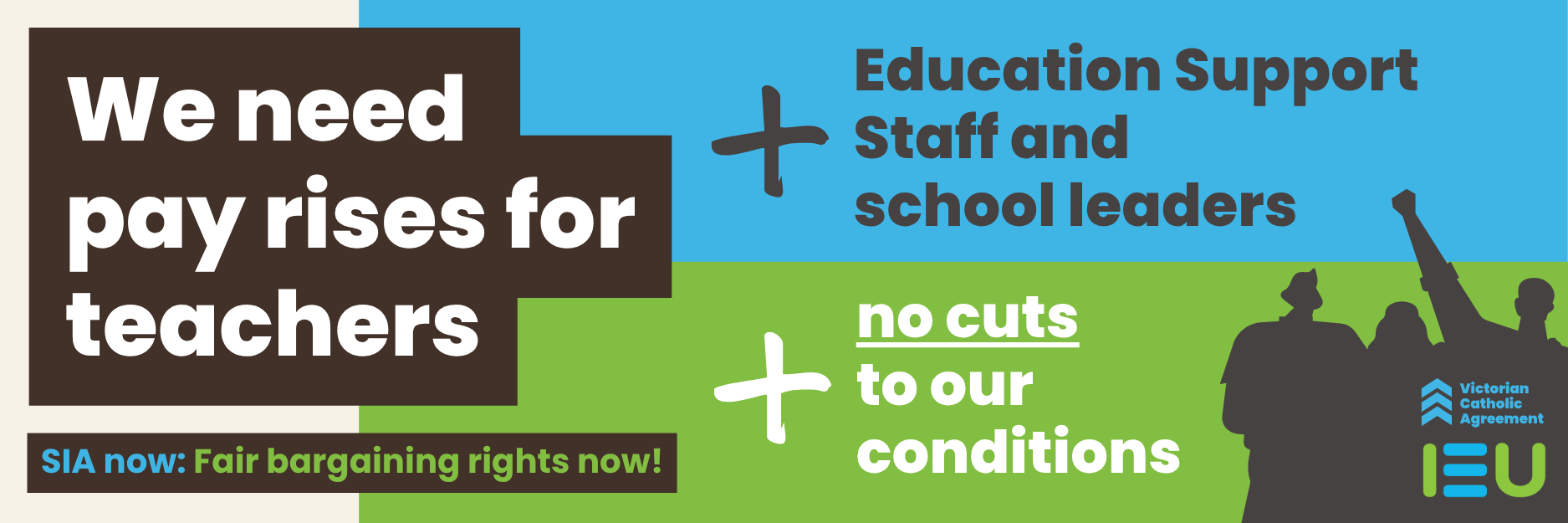
The IEU is calling on Catholic employers to withdraw the backpay deadline, match all salaries and allowances paid in government schools, provide outstanding draft clauses and negotiate genuine improvements to workload and existing protections.
Dirty Dozen countdown
The IEU’s Dirty Dozen series examines twelve key concerns with the offer, drawing on members’ survey responses and the bargaining team’s analysis.
Each instalment explains a proposed cut to existing entitlements or a failure to address workload. We ask members to share the series with colleagues so every staff member understands what is at stake!