
IEU member seeks secondary teachers for Honours research into wellbeing

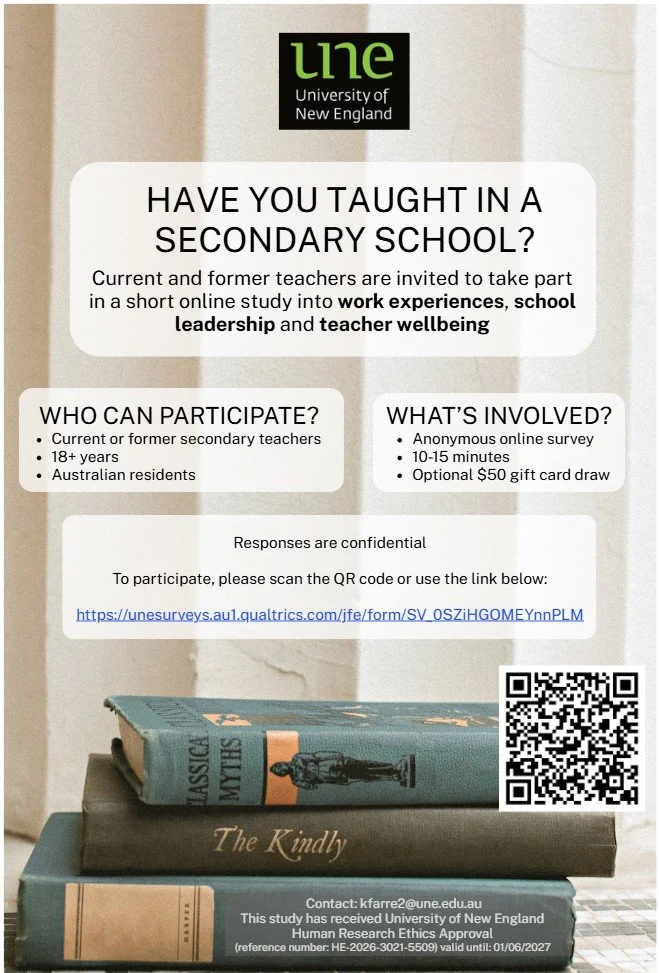
Karen Lichnovsky, a teacher and IEU member completing Honours in psychology, is looking for current or former secondary teachers to complete a short survey that explores how workplace conditions contribute to emotional exhaustion.
Help Karen by completing the 15-minute survey here.
Participants can enter a random prize draw for one of 6 $50 Coles / Myer gift cards.
Karen says, “I'm really keen to capture as many voices as possible for this research and hope that it may lead to better understanding teacher workloads and the pathway from psychosocial safety climate to emotional exhaustion/burnout.”
The study, Psychosocial Safety Climate as an Organisational Antecedent to Job Demands and Exhaustion in Teachers, seeks to clarify how workplace environments influence teacher wellbeing.
It examines how four key job demands - quantitative demands, work pace, cognitive demands, and emotional demands - affect the psychosocial safety of teachers in schools.
It forms a crucial part of Karen’s Honours research project within the School of Psychology at the University of New England (UNE).
Psychosocial safety and educator wellbeing are primary concerns of the IEU. You can read more of our articles about these topics here.
Our most recent article on these topics defines psychosocial hazards as, “aspects of work that can affect a person’s mental health, wellbeing, and safety. They arise from how work is organised, managed, or experienced, rather than from physical dangers”.
Safe Work Australia (SWA) defines a “psychosocial hazard” as anything at work that could cause psychological harm. Hazards can arise from work design, the environment, workplace interactions, or behaviours.
Many aspects of a teacher’s work may qualify as psychosocial hazards. Examples include:
Exposure to aggressive student behaviour
High workloads or unrealistic deadlines
Poor job control or lack of decision-making authority
Role conflict or ambiguity
Bullying, harassment, or discrimination
Job insecurity or unfair treatment
Poor support from managers or colleagues
Stressful interactions with clients, students, or the public.
The survey
Eligible participants are individuals aged 18 years or older who are currently employed (full-time, part-time, or casual) are encouraged to complete the survey. Participation involves completing an anonymous online survey, which takes approximately 15 minutes. The survey includes questions about workplace experiences, job autonomy, ability to psychologically detach from work, and overall wellbeing.
