Independent school snapshot: Fernbrook School, Mount Dandenong
Fernbrook School is situated on Wurundjeri land at the foot of Mount Dandenong, set on 20 acres of magnificent dense bushland. It “facilitates student-led learning” across four multi-age classes – from Prep to Year 10.
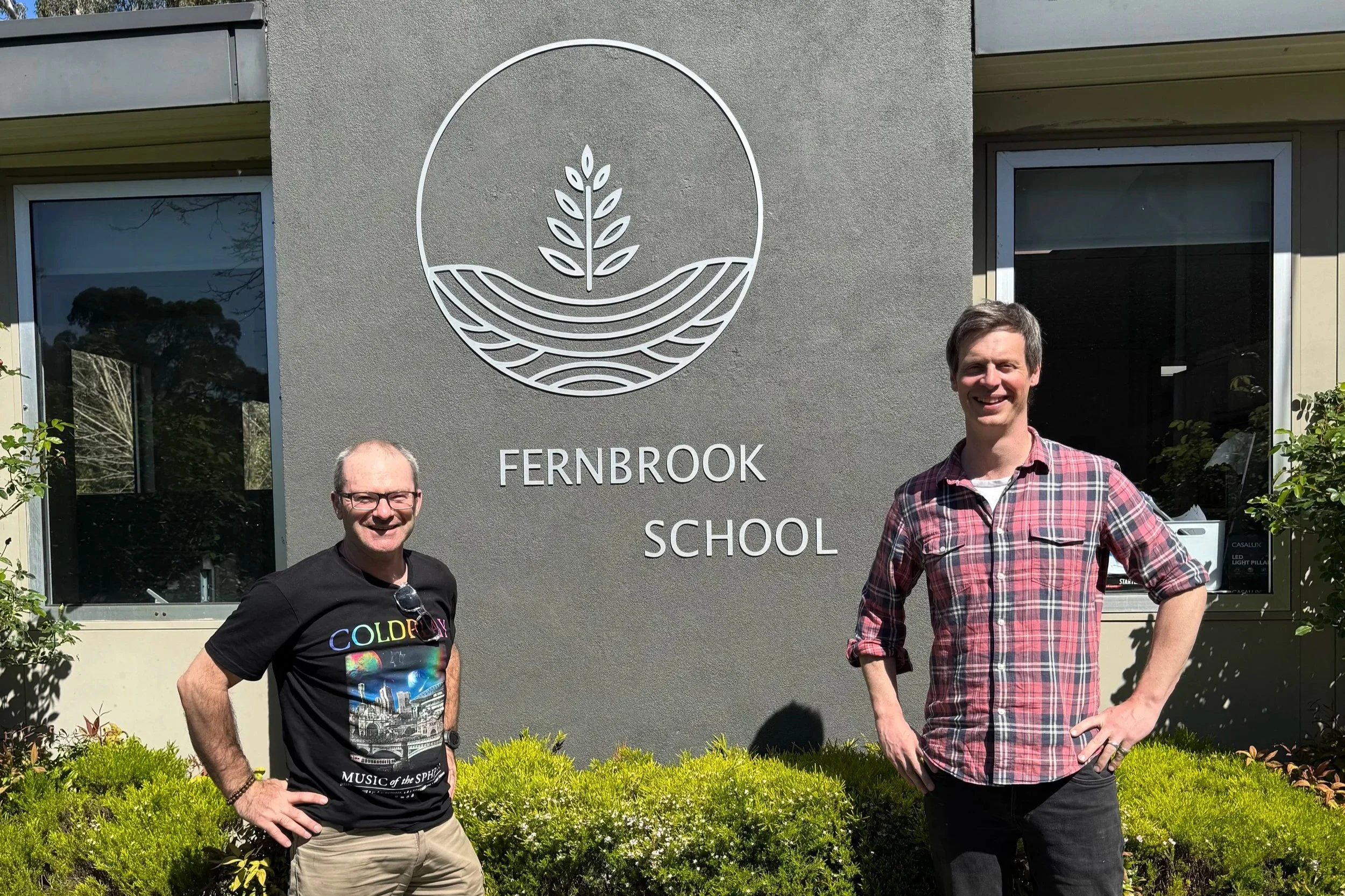
Ralph and IEU member Craig at Fernbrook.
Fernbrook IEU rep Ralph Horn says it was originally “a farm school” when established seven years ago and has since evolved into “an inclusive and safe environment for democratic education and student-led learning”.
“We have a steadily growing student body of around 85 across prep to year 10, supported by 5 full time and 8 part-time teachers and a target level of 10 students per year.” Most of those teachers – and eight support staff – are IEU members.
Ralph describes Fernbrook as a “relaxed and informal environment with no uniforms and everyone is on first name terms”.
Ironically, one of the biggest challenges at the school is presented by its idyllic setting. Ralph says it can be difficult to maintain “professional and consistent employment conditions”.
“Being a young school, there has been a heavy workload for some to bed down curriculum and data recording systems and we lean into our IEU relationships for support. We are proud of having nearly 100% unionisation and our HSE team have made some very welcome improvements to our school environment.”
Staff unanimously voted for an EBA last year, and the union has begun preparing the next Agreement. “We look forward to having a Fernbrook Agreement in place to ensure a fair and safe workplace where staff feel heard, appreciated and don’t want to leave,” says Ralph.
At a glance: Fernbrook School, Mount Dandenong
Student numbers: 85
Ethos: One of its guiding principles is the quote often attributed to Albert Einstein: "Play is the highest form of research". Established by individuals who examined “best practice from around the world”, the Fernbrook School Philosophy informed by “social constructivist theory and the Reggio Emilia movement, where “the importance of creativity (is) translated into practice”. Other influences include: Positive Psychology (Martin Seligman); the importance of the natural world in education; Collectivism and Restorative Practices; and Play Based/Experiential Learning Theory.
The IEU represents staff across a diverse range of schools – from large faith-based systems to small, specialist independents. We will continue to provide these profiles of these unique schools and the IEU members working in them.
To propose your workplace for a feature in The Point, contact your Organiser or email: thepoint@ieuvictas.org.au