Why our union grew when others declined
In 2008, Terry Wilson, drawing on over 30 years’ experience in Catholic education negotiations, completed a thesis on why the VIEU – the largest predecessor of IEU Victoria Tasmania – had achieved what few Australian unions managed between 1994 and 2004: growth.
An investigation of the union membership of teachers in Victorian Catholic schools during the period 1994 to 2004 acknowledged that most unions declined – despite enduring public support – because ‘they were squeezed by hostile governments, restrictive laws, economic change, and shifting work patterns.’ Wilson examined the ‘extraordinary counter trend’ in Victorian Catholic schools, where teachers increased union membership by 82.5% and density by 56%. His work remains a valuable record. Few unions, being living organisations of busy working people, have the comprehensive histories they deserve, and work like his helps fill the gaps.
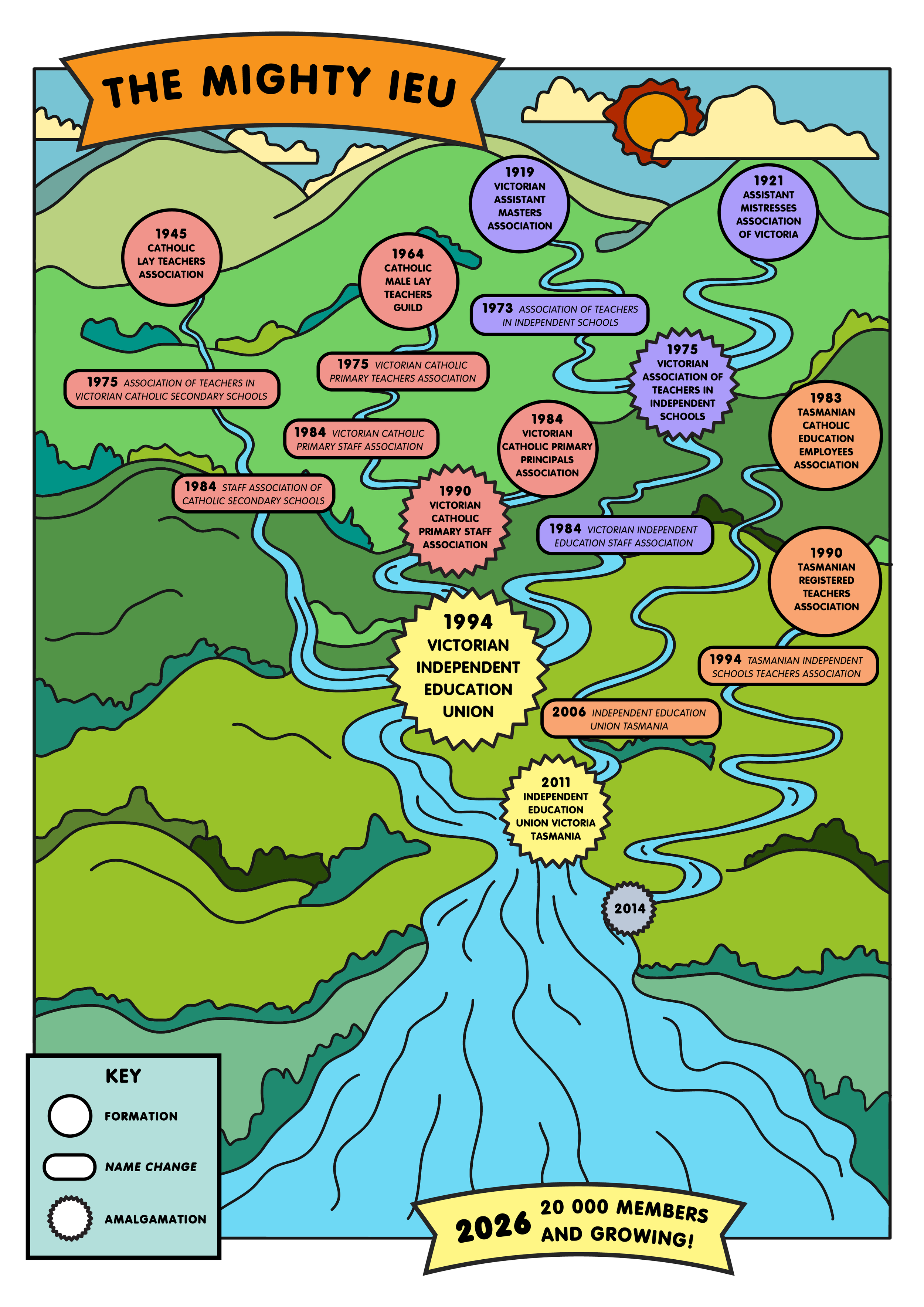
The IEU Victoria Tasmania’s history stretches back to 1919, but the largest forebear of the current iteration is the Victorian Independent Education Union (VIEU), which was formed in 1994 from the merger of various associations representing staff in independent schools and Catholic schools. VIEU became IEU Victoria Tasmania in 2011 after merging with IEU Tasmania. Amalgamation with the Tasmanian Independent School Teachers Association (TISTA) was finalised in 2014. Wilson’s thesis offers a fascinating insight into VIEU’s first decade. He used the ‘three-legged stool’ analogy to explain ‘the vicissitudes of union growth’: a favourable work environment, a supportive sociolegal framework and good union leadership.
If one leg is missing the stool cannot stand; union growth cannot occur.
If one leg is short, growth is lopsided.
If one leg is weak, growth is precarious.
When the three work interdependently, the strongest growth occurs. In VIEU’s case, Wilson concluded, leadership was paramount, outweighing the other two factors.
What VIEU got right – and how it got lucky
Wilson observed that while the union movement’s unions@work campaign (1999–2000) urged unions to adopt a more participative model beyond wages, the VIEU had, since 1994, already been ‘using a genuine grassroots approach to unionism and in a conscious way’. Michael Flinn, the first Secretary (1994–1999), told Wilson: ‘Other unions talk about it … but VIEU did it.’ His successor Tony Keenan said that, as a new entity, VIEU had the advantage of ‘starting with a blank sheet … [to] build a participative and democratic structure.’
Role of the members
Flinn said the union’s structure made it ‘a very democratic and very participative organisation … the profession wouldn’t tolerate anything else.’ Wilson’s interviews revealed that ‘the collegial nature of the teacher profession … demanded a collegial way of acting as a union.’ Sometimes this proved challenging to leadership! Flinn admitted members ‘overwhelmingly forced’ leaders to adopt positions, joking he ‘got his head beaten in’ when he resisted. Several campaigns ran only because of direct member pressure.
Classroom experience for staff
Another factor was that Organisers were former teachers, essential ‘to have credibility and understanding of the school scene.’ Flinn said the union bucked membership trends because ‘we all came from the industry … embedding ourselves in the culture of the industry.’
Big picture issues
Wilson’s surveys found teachers joined VIEU to advance both social justice and industrial advocacy. Members valued collaboration with employers and saw good leadership as listening to professionals and involving them directly in shaping policy and campaigns.
Catholic values
Then, as now, Catholic employers were meant to respect and nurture employees. The Church and unions had long been ‘natural allies in defending the right of workers to a just wage and human dignity.’
Guiding principles included:
dignity of work
the right to work and to withdraw it
collective representation
a just family wage
Wilson quoted Pope John Paul II in Laborem Exercens: ‘Employees and employers should be regarded as partners … mutual respect, esteem and goodwill should underpin the relationship.’ When Catholic employers failed to uphold these standards, the union’s role became more vital.

Other insights from the Wilson thesis
Industry – Until the 1980s, teachers couldn’t register as unions because the High Court ruled education wasn’t an ‘industry’; this changed in 1983, allowing formal representation.
Vocation – Teachers saw their work as a vocation, focused on mission and quality education as well as wages. ‘Teachers are as much concerned with how they shall fill young minds as they are with filling their own pockets.’ VIEU had to respect this to attract members.
Values – VIEU drew on Catholic social teaching supporting unions and workers’ rights, tailoring strategies to teachers’ identity and expectations.
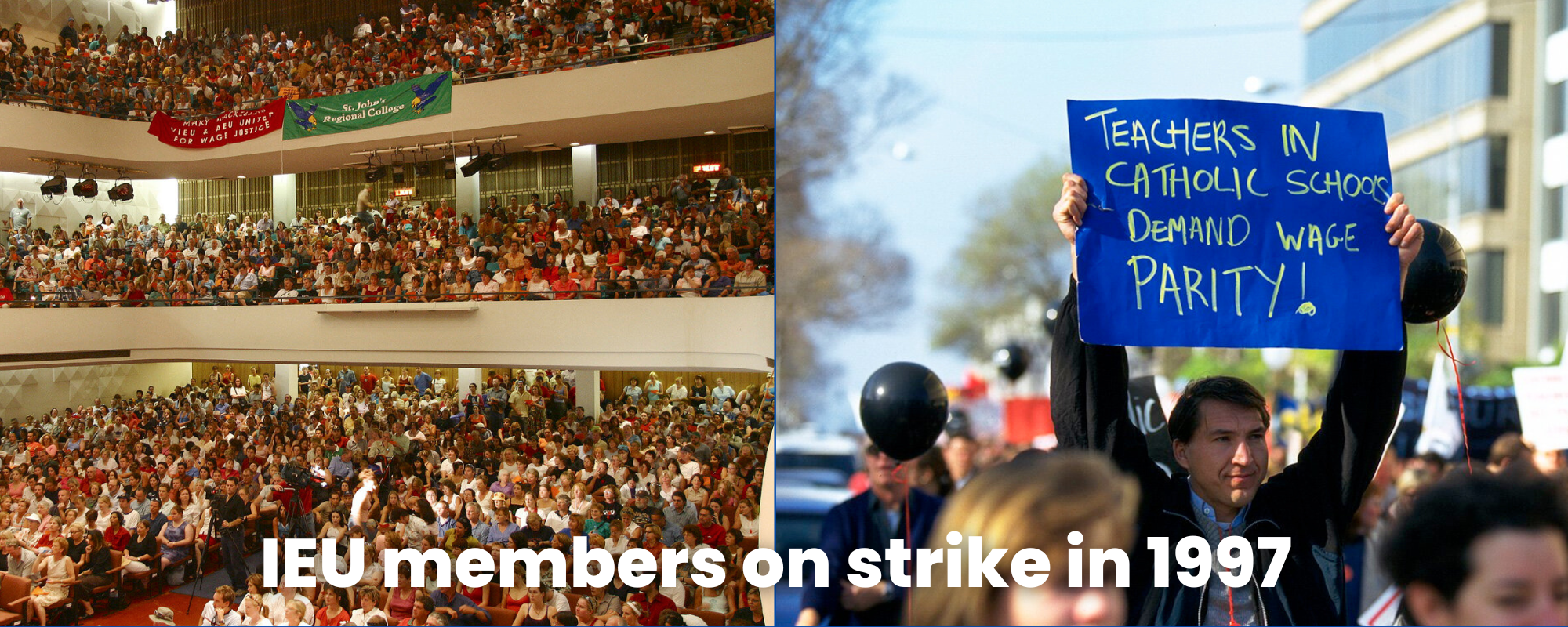
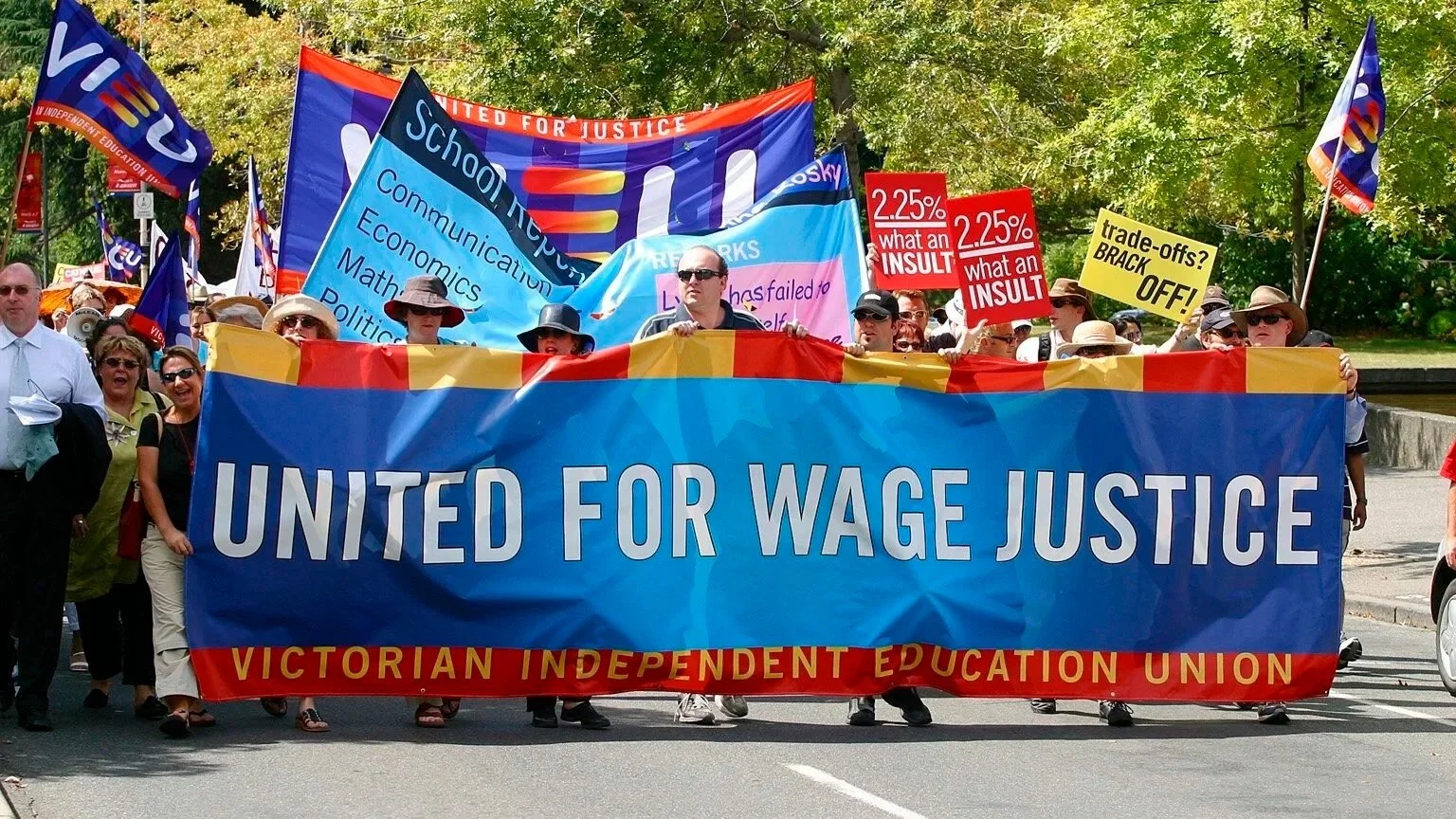
Strikes – The Kennett government’s cost-cutting, market-driven education agenda in the 1990s spurred industrial action. The 1990 strike added 1,000 members and the 1997 campaign for pay parity with the state sector brought 600 new members in six weeks. Union density was strengthened by work bans and actions including rallies in front of Catholic Education headquarters and whole day strikes.
Wilson concluded that VIEU succeeded because it listened to teachers, worked with them, and delivered real change. Facing the same challenges as other unions, ‘good leadership, member engagement, solidarity among teachers, and constructive employer relations allowed it not just to hold steady but to grow’.