Victorian Catholic school employers claimed last year that they ‘do not wish to engage in processes that may distract or delay an agreement’.
History tells another story.
Slow starts and stalling
After IEU members tabled their Log of Claims in February 2021, Melbourne Archdiocese Catholic Schools (MACS) waited until Term 4 to issue paperwork for formal talks. The glacial progress on non-salary claims was ‘deeply frustrating.’
By February 2022 – with a deal overdue – hundreds of members sent ‘solidarity selfies’ demanding action on pay, conditions, and workloads. Meetings remained unproductive.
Two speeds of bargaining
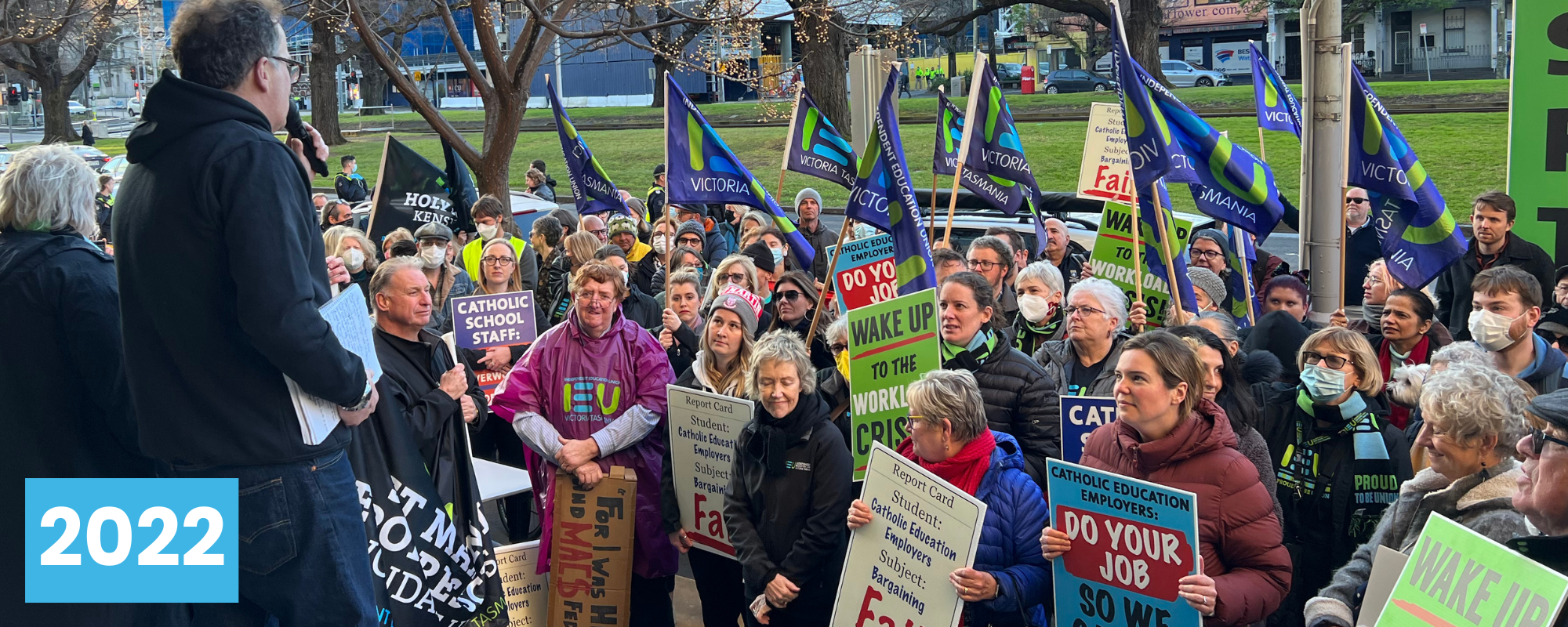
While the Sale Diocese negotiated constructively and reached a deal by Term 3, MACS stalled, expecting ‘something in return’ for every improvement. Members gave MACS a FAIL in the Report Card campaign.
Escalating action
IEU members increased pressure through a rally at MACS HQ, a statewide media blitz, sub-branch motions, and the No More Freebies campaign – refusing unpaid extra work. Actions included email bans, event boycotts, walkouts, petitions, and strict meeting-time limits.

At last
By Term 4 2022, a deal was finally reached thanks to cumulative pressure: Senate testimony, letters to parents, rallies in freezing rain, walk-ins, media coverage, and tireless member action.

Due to funding uncertainties and internal disagreements, employers claim they are unable to commit to a multi-year Agreement and the IEU agrees to a one-year MoU to lock in salary increases.
Following this, delays resulting from the constant turnover in the team representing Catholic employers leads the IEU to report that “the pace would make a tortoise look nimble and we have spent valuable time having to go over old ground.”

Thousands of staff in Victorian Catholic education are compelled to take unprotected industrial action twice to achieve a new Agreement after Catholic employers refuse to budge on key demands for over two years.
Catholic employers sought an injunction and threatened to fine not only the IEU but also each individual employee who took part.
A deal for government school staff was reached in April 2013. However, the Victorian Catholic Agreement took many months longer to finalise and was not approved by Fair Work until 13 November, after nearly two years of campaigning by IEU members.
While the IEU successfully negotiated backpay to ensure that staff were not disadvantaged, this extraordinary 7-month delay highlighted again the disadvantages of bargaining without key industrial rights.
Our recent article on this campaign stated:
“The 2012–13 dispute marked a clear shift in the Catholic sector: employers increasingly relied on the sector’s multi-employer structure and legal constraints to limit coordinated action and delay bargaining.”
Sadly, it’s been delays ever since.
This time around: 2025-2026
Bargaining could have begun in earnest last year, and by now likely be nearing completion if employers had agreed to single-interest bargaining when we first asked. Instead, the IEU needed to pivot campaigning in Term 4 last year to mobilise thousands of staff to sign Statements of Support.
In October 2025, employers made an “offer” designed to circumvent proper bargaining and lock in a deal when employees were least empowered. The gambit failed, as Catholic staff saw it for what it was: a cynical attempt to deprive them of a voice.
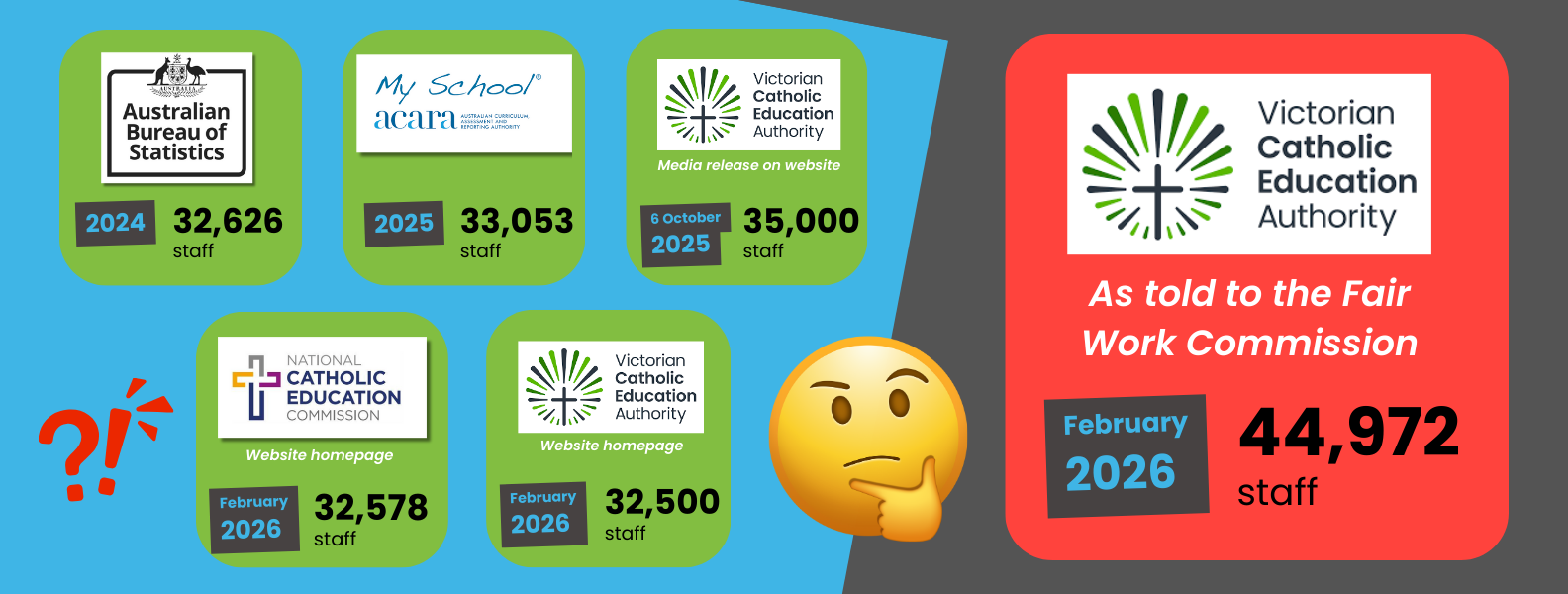
In early 2026, employers initially submitted inflated workforce figures, stalling the SIA application. The VCEA claimed 32,500 staff on its website (6 February 2026), while submitting a list of 44,970 to the independent ballot agent. After review, over 7,200 names were removed, but remaining figures, still higher than public data, require further scrutiny.
Delays as usual
When employers say bargaining has “always been done this way,” caution is warranted. In Victoria, “business as usual” has often meant division, delay and dysfunction, limiting the IEU’s ability to use key industrial mechanisms on members’ behalf.
By contrast, Catholic school employers in every other Australian state negotiate as a single interest. If Victorian employers were genuinely united, they would do the same.
When they say, “trust us,” their record suggests otherwise ̶ real progress has come only through collective pressure from IEU members.