Kylie De Calmer: Why music belongs in every classroom
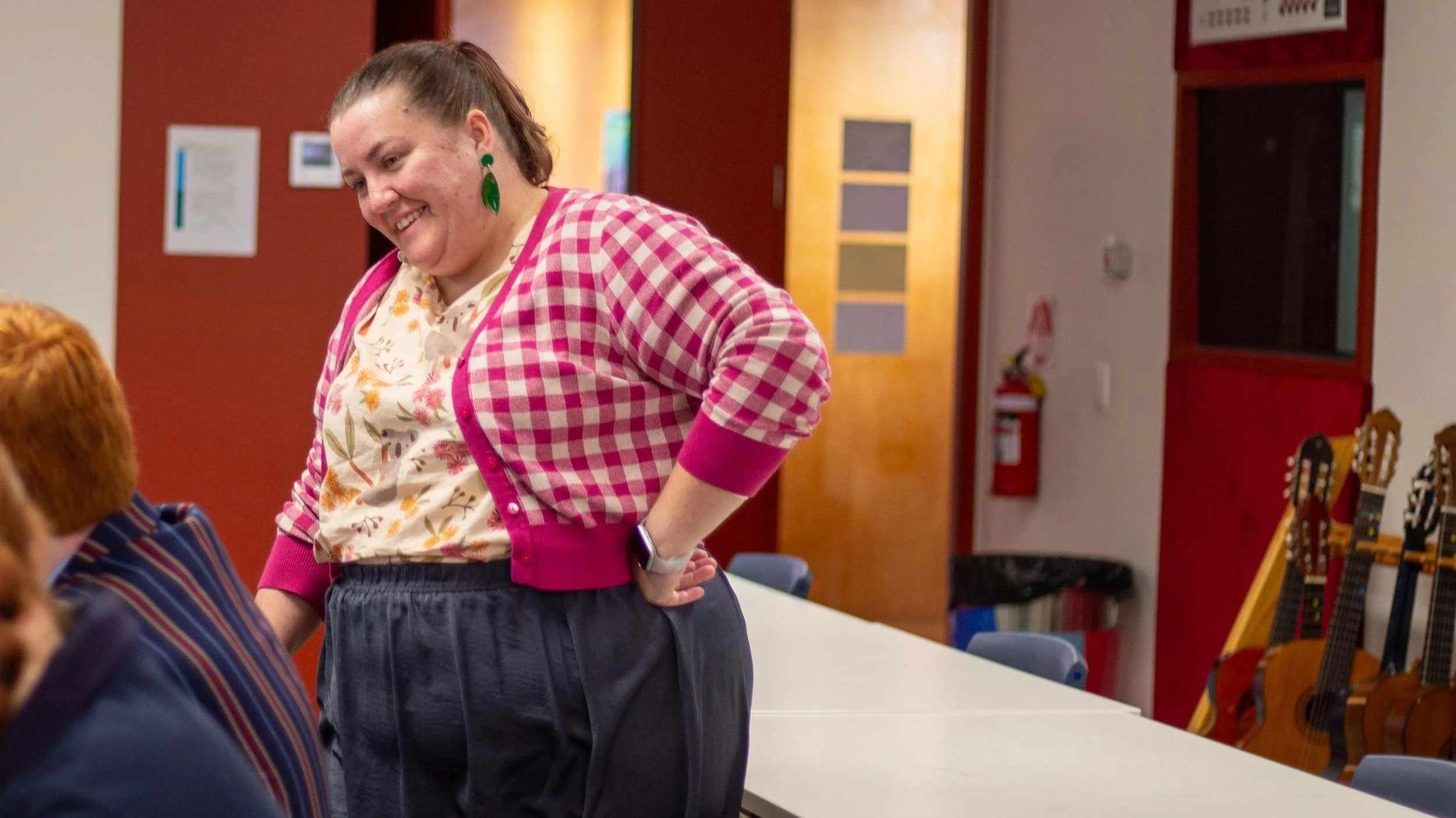
Kylie De Calmer believes we have lost sight of the benefits of music. She says, ‘The arts hold us together, but they’re the first things we lose’.
The week Kylie spoke to The Point, seven live music venues in Hobart closed down.
‘They’re the first thing to go in a recession, because we’re not funding it from the top, so why would it be valued at the bottom?’
When music becomes an afterthought
She sees a similar pattern in schools.
Kylie says many senior students do not choose music electives ‘because they don’t see it as a benefit to their career… They’re only in grade 9 and 10, and they’re already thinking ‘I need biology to get my medical degree’…’
Kylie brings a broad perspective to the challenges facing music education.
She has 10 years’ experience as a music teacher in the Queensland Education Department, teaching across primary and secondary schools, including in regional Queensland and Mt Isa.
After moving to Tasmania, she joined Dominic College, where she teaches seven music classes across Years 6, 7, 9 and 10, leads student and staff choirs, and supports the school’s instrumental and ensemble programs in a team of three classroom music teachers.
She appreciates Dominic College’s commitment to music – every student in Years 6 and 7 plays a concert band instrument – after experiencing schools where music was sidelined.
‘I never felt, especially in primary schools, that music was seen as a valuable enough subject for me to be part of the main education team. I was treated as a provider of non-contact time for classroom teachers rather than as an educator with an important role in student learning.’
At some schools, music was interchangeable with other arts subjects.
‘I was employed as a music teacher, and when I got there, I was told: term one, you teach music; term two, you teach dance; term three, art; term four, drama.’
Building music education from the ground up
Kylie says music education has become fragmented and inconsistent, despite requiring ‘a cohesive and sequential program’ that builds skills from early childhood through to Year 12.
She believes there is a misunderstanding about the importance of music for young people. Like Nick Cowall, she points to the work of Dr Anita Collins, who says:
‘Learning music provides children with the cognitive foundations for effective learning’, and ‘learning to play music is the neurological equivalent of a full-body workout’.
Kylie says the decline of regular classroom singing weakened music’s place in schools.
‘Teachers just don’t sing in classes anymore…’
Even when she prepared resources to help colleagues include music in their classrooms, workload pressures often prevented participation.
‘They could not find the time amongst all of the other constraints. It’s not a malicious thing, it’s just almost impossible now.’
Valuing music education
Kylie is adamant that music is not simply an ‘optional extra’.
‘The first thing mothers do is sing to their children. We have evidence of bone flutes from thousands of years ago. Humans have been making music as long as we’ve been humans, and I think you know, if we’re not making music with our children, I think we’re going to lose part of our humanity…’
Kylie is pragmatic enough to say that ‘artsy fartsy’ arguments about music’s cultural importance alone will not persuade decision-makers.
Instead, to promote music’s position in education, she believes we need to highlight Dr Collins’ research about the benefits of music for young people.
‘We’re improving not only their cognition, but their mental health, their wellbeing, their contribution to society and their critical thinking skills, which are more valued than ever.’
The Point music education feature:
Feature: Music is more than an optional extra
Sarah Nieuwkerk: From the concert hall to the classroom
Nick Cowall: Music belongs to everyone
Karman Melitsis: Making music part of school life
Dr Johanna Selleck: A life in music, a life of teaching